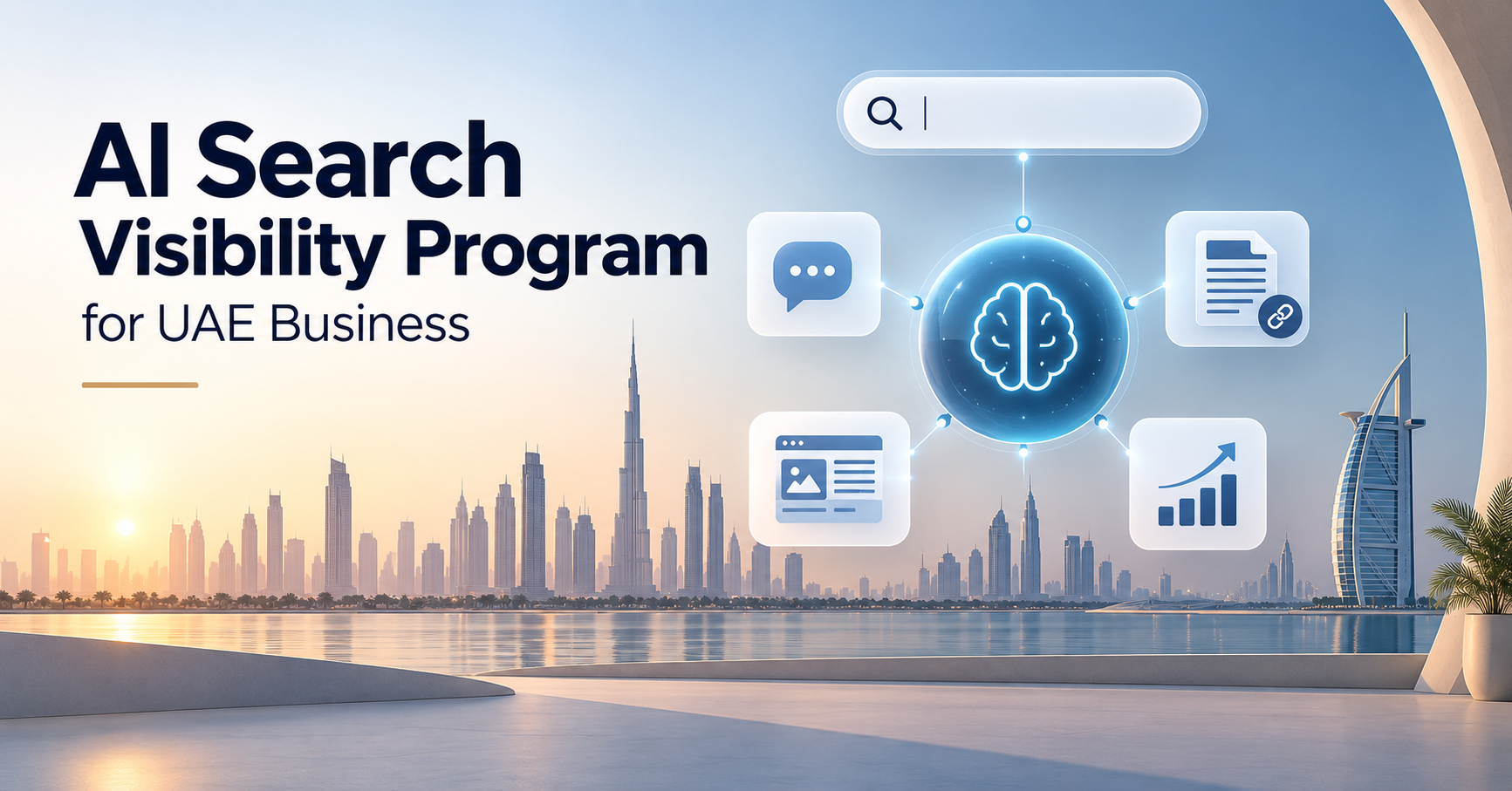
AI search is becoming another layer of customer discovery.
The important change is not that customers have moved from Google to ChatGPT, Claude, Perplexity or another platform. Different people will use different search and AI environments depending on the question, category and buying journey.
For a UAE business, the more useful question is:
When customers ask commercially important questions about our category, are we present in the search and AI environments they use?
That is the foundation of an AI search visibility program.
Google reported in May 2026 that AI Mode had passed one billion monthly users, while queries had more than doubled every quarter since launch. At the same time, overall Google Search queries reached an all-time high. Google Search's May 2026 AI update
The implication is important. AI is not simply replacing search. It is expanding the types of questions people are comfortable asking.
Step 1: Decide which AI surfaces matter
Do not attempt to optimise equally for every model.
Start with the audience.
Google Search, AI Mode and Gemini matter because AI is increasingly becoming part of mainstream search behaviour. This is particularly relevant for the UAE and MENA because Google has already rolled AI Mode out in Arabic and says the experience uses a technique called query fan-out, breaking a question into subtopics and conducting multiple searches simultaneously. Google's explanation of AI Mode in Arabic and query fan-out
ChatGPT should be monitored across most categories. OpenAI confirms that public websites can appear in ChatGPT Search and recommends allowing OAI-SearchBot when a business wants eligible content to be discovered and cited. It also provides a way to identify referral traffic from ChatGPT in analytics. OpenAI guidance for publishers and website owners
Claude should be viewed as another research surface, not only as a coding assistant. Anthropic says Claude's web search can generate targeted queries, retrieve current information and provide citations to the underlying sources. The company highlights applications ranging from research and financial analysis to sales intelligence and product comparison. Anthropic on Claude web search
Perplexity is also important because web retrieval and citations are central to the product. It describes itself as an AI-powered search engine that searches the web in real time and provides citations linking back to original sources. How Perplexity search works
Microsoft Copilot becomes particularly relevant where enterprise customers operate heavily inside the Microsoft ecosystem.
Action: Select three to five AI/search environments based on actual customer behaviour. For many UAE businesses, Google/Gemini, ChatGPT and Perplexity provide a useful baseline, with Claude and Copilot added where relevant.
Step 2: Build the question set from customers
Do not begin with an AI keyword tool.
The strongest questions are usually already inside the company.
Review:
- sales-call transcripts
- demo recordings
- WhatsApp enquiries
- CRM objections
- lost-deal notes
- support tickets
- customer interviews
- Search Console
- customer reviews
Look especially for questions customers ask before they know exactly which provider they need:
- Which approach is best for a UAE company?
- Which providers should we evaluate?
- What does implementation normally take?
- What should this cost?
- What are the risks?
- Does this meet UAE requirements?
- How does the approach change between the UAE and Saudi Arabia?
- Is Arabic support important?
These questions are much closer to AI-search behaviour than isolated keywords.
The reason Google's query fan-out concept matters here is that one complex question can potentially result in searches around several related subtopics.
That changes the content strategy.
Do not optimise one page for one AI prompt. Build enough depth to answer the decision behind the prompt.
Action: Build an initial set of 30 to 50 commercially important questions from real customer conversations. Add UAE, Dubai, Abu Dhabi, GCC, Saudi Arabia and Arabic variants only when they reflect real customer behaviour.
Step 3: Establish the visibility baseline
Run substantially the same question set across the platforms you selected.
For every query, record:
- whether your company appears
- which competitors appear
- whether your domain is cited
- which third-party sources are cited
- which page is referenced
- whether the company is described correctly
- whether results differ between English and Arabic
Do not judge performance from a favourable screenshot.
AI-generated answers can vary. What matters is the pattern across commercially important questions.
A simple monthly scorecard needs only four measures:
Brand visibility: how often the company appears.
Citation visibility: how often your domain is referenced.
Competitive share: how frequently major competitors appear.
Source gap: which external sites repeatedly influence answers where you are absent.
Microsoft is already exposing this type of measurement through Bing Webmaster Tools. Its AI Performance report shows total citations, cited pages and some of the grounding queries used when retrieving content for AI-generated responses. Microsoft's AI Performance reporting in Bing Webmaster Tools
Action: Capture the baseline before changing the strategy, then rerun substantially the same question set each month.
Step 4: Fix discoverability before producing more content
AI visibility still depends on basic search fundamentals.
The chain remains approximately:
Crawling → Indexing → Understanding → Authority → Retrieval → Citation
Check whether:
- important pages are crawlable and indexed
- canonicalisation is correct
- internal linking exposes priority pages
- titles and headings clearly explain page purpose
- JavaScript does not hide essential information
- sitemaps are current
- product, service and location information is consistent
- significant claims have evidence behind them
For ChatGPT, confirm that OAI-SearchBot is not unintentionally blocked if search visibility is desired. OpenAI's website discovery guidance
There is also a simpler business test.
Ask sales for the five things they have to explain repeatedly.
If those answers are difficult to find on the website, fix that before producing another 50 articles.
Step 5: Build content around decisions, not topics
Suppose someone asks:
What employee-benefit structure is appropriate for a 200-person company in Dubai?
A useful answer may require information about:
- UAE requirements
- company size
- pricing
- coverage
- claims
- implementation
- provider options
- employee expectations
One generic article about employee benefits is unlikely to answer that decision properly.
A stronger content set could include:
- the commercial service page
- implementation guidance
- pricing or cost framework
- comparisons
- UAE-specific requirements
- buyer FAQs
- original benchmark data
The objective is not more pages.
It is fewer information gaps around commercially important decisions.
Step 6: Create information worth citing
Getting indexed does not automatically make information worth referencing.
Generic articles such as “What is CRM?” or “What is KYC?” provide little information advantage.
More defensible assets include:
- UAE benchmarks
- proprietary datasets
- surveys
- pricing research
- calculators
- market maps
- regulatory comparisons
- implementation benchmarks
- annual industry reports
This becomes particularly important on citation-led research platforms. Perplexity, for example, says every answer includes links to original sources so users can verify and explore the underlying information. Perplexity's explanation of citations and source transparency
For UAE-specific factual content, use regulators, ministries and official government sources wherever possible.
Action: Produce at least one genuinely reference-worthy UAE or MENA asset every quarter.
Step 7: Build authority outside the website
AI visibility should not become another isolated SEO exercise.
One strong piece of research can become:
- a long-form article
- PDF report
- chart or infographic
- YouTube video
- LinkedIn carousel
- short expert commentary
- sales enablement material
For technical businesses, documentation can be equally important: API references, integration guides, developer tutorials and changelogs.
For UAE businesses, credible regional mentions also help establish market relevance. Industry publications, associations, government initiatives, partners, customer case studies and sector-specific communities can all strengthen how the company is understood.
The objective is not to manufacture mentions.
It is to create enough reliable evidence that customers and multiple retrieval systems can independently understand what the company represents.
Step 8: Run it as a 90-day program
During the first 30 days:
- select priority AI platforms
- create the customer-question set
- establish the visibility baseline
- audit technical accessibility
- identify competitor and citation gaps
During days 31 to 60:
- improve weak commercial pages
- answer recurring sales questions
- strengthen UAE/MENA information
- build missing topic depth
- publish the first citation-worthy asset
During days 61 to 90:
- distribute the strongest content
- create PDF, video and visual formats
- strengthen relevant external references
- rerun the benchmark
- compare visibility across platforms
Then repeat the cycle quarterly.
The goal is not to “rank number one in ChatGPT.”
There is no single AI ranking to win.
A more useful objective is:
When customers ask commercially important questions about our category, are we consistently part of the answer across the search and AI systems they actually use?
Businesses that build durable AI visibility will not chase every new model.
They will understand what customers ask, make their information technically accessible, answer those questions better than competitors and publish evidence worth citing.
When those foundations are strong, Google, ChatGPT, Claude, Perplexity, Copilot and future search systems have a much better chance of independently reaching the same conclusion:
this business belongs in the answer.