LinkedIn bidding is not just a media buying setting.
It determines what LinkedIn should optimize for, how aggressively the platform competes in the advertising auction, and how your budget gets translated into impressions, clicks, leads or conversions.
For customer acquisition, the wrong bidding setup can create misleading efficiency. You may get cheaper clicks without qualified leads, high delivery without sufficient reach, or repeated impressions to the same small audience.
The better starting question is:
What is the strongest business outcome we can realistically ask LinkedIn to optimize for with the data available today?
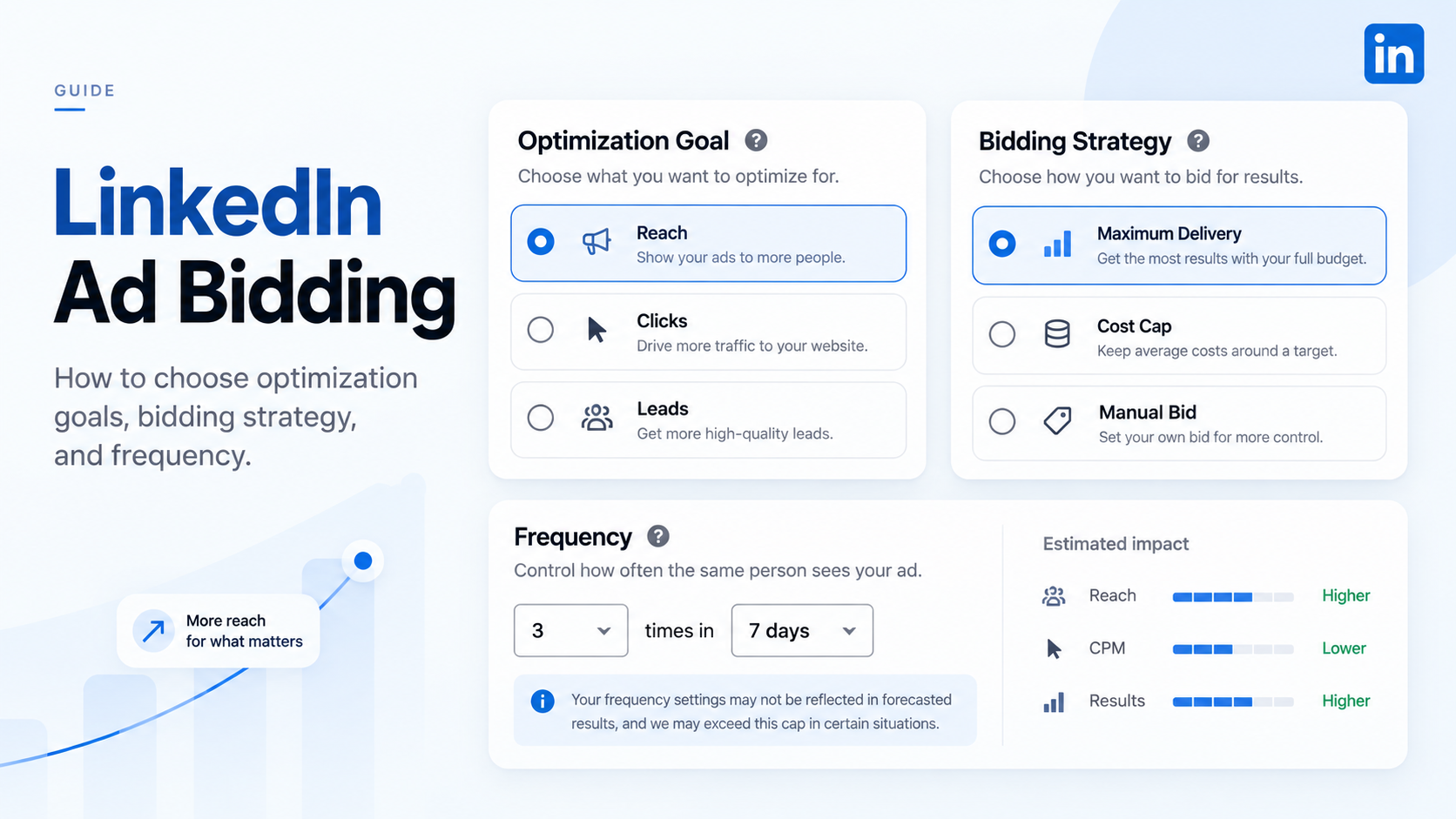
LinkedIn currently offers three core bidding strategies: Maximum Delivery, Cost Cap and Manual Bidding. Which options are available depends on the objective, ad format and optimization goal selected. LinkedIn's current bidding strategy guidance
Start with the optimization goal, not the bid
The optimization goal and bidding strategy solve different problems.
The optimization goal tells LinkedIn which result matters.
Depending on the campaign setup, this could include:
- reach
- impressions
- landing page clicks
- engagement
- video views
- leads
- qualified leads
- conversions
The bidding strategy determines how LinkedIn competes in the auction to generate that result.
LinkedIn explains that its ad auction considers both bid price and predicted relevance to the member. This means paying more does not automatically guarantee better delivery. Audience quality, creative relevance and bidding all influence whether an ad wins an auction. LinkedIn's explanation of its advertising auction
For acquisition campaigns, the goal should gradually move closer to revenue.
If the business has enough CRM or Conversions API data, LinkedIn can also optimize Lead Generation campaigns toward qualified leads rather than treating every form submission equally. LinkedIn's qualified lead optimization guidance
Action to take: Write down the one event you actually want the algorithm to learn from. Do not optimize indefinitely toward clicks if the real business goal is qualified pipeline.
Maximum Delivery: usually the best starting point
Maximum Delivery is LinkedIn's automated bidding strategy.
LinkedIn uses machine learning to adjust bids automatically with the aim of generating as many key results as possible while efficiently using the available budget. Depending on the objective, those results can include impressions, clicks, leads or conversions. LinkedIn recommends Maximum Delivery when advertisers want to understand the performance potential of their budget. LinkedIn's Maximum Delivery guidance
This makes Maximum Delivery useful when:
- launching a new campaign
- testing a new ICP
- entering a new geography
- introducing a new offer
- historical CPL or CPA is limited
For an early stage UAE software company expanding into Saudi Arabia, for example, guessing what a Saudi finance decision-maker click should cost may be premature.
Let the campaign establish the natural performance range first.
The trade-off is cost control. Maximum Delivery is designed to generate results and use the budget, not maintain a fixed cost per lead.
Action to take: Use Maximum Delivery when you need learning. Once performance stabilizes, use the observed CPL or CPA to decide whether tighter control is necessary.
Cost Cap: use it once you understand the economics
Cost Cap lets you provide a desired cost per result. LinkedIn then uses that number as a benchmark while adjusting bids automatically.
The important word is benchmark.
LinkedIn states that the actual average cost can still differ from the cap because auction conditions change. LinkedIn's Cost Cap documentation
Suppose historical campaigns consistently generate qualified leads between AED 500 and AED 650, and the business can economically support AED 700.
A Cost Cap around those actual economics has a rational basis.
Setting it to AED 200 simply because that is the CPL marketing would prefer can restrict delivery.
The system may stop entering enough auctions to produce meaningful volume.
LinkedIn also says Cost Cap campaigns experience more fluctuation during the first seven days and recommends running them for at least 15 days to give the system enough time to optimize. Changing the audience, strategy, creative or Cost Cap can reset learning. LinkedIn's Cost Cap learning guidance
Action to take: Base your first Cost Cap on demonstrated performance. Tighten it gradually rather than forcing an aspirational CPL on the system immediately.
Manual Bidding: use it when control is genuinely necessary
Manual Bidding lets the advertiser set the bid amount.
Depending on the objective and format, charging can be based on CPC, CPM, CPV or cost per send. LinkedIn notes that bids set too low can reduce competitiveness and delivery, and advertisers may need to adjust bids throughout the campaign. LinkedIn's Manual Bidding guidance
Manual Bidding can make sense when:
- the audience is very specific
- auction economics are understood
- bid control is strategically important
- someone is actively managing the campaign
This can be relevant for UAE institutional campaigns where the addressable universe may consist of a relatively small number of banks, large enterprises or strategic accounts.
But an artificially low bid is not efficiency.
If you save money per click but barely reach the people who matter, the campaign has not succeeded.
Action to take: Monitor both cost and delivery when using Manual Bidding. Do not optimize CPC in isolation.
Work backwards from customer economics
The easiest way to judge whether a bid is expensive is to connect it to the funnel.
Assume the business can afford AED 800 for a qualified lead.
If 10% of relevant landing page visitors eventually become qualified leads, then:
AED 800 × 10% = AED 80
That gives an approximate economic ceiling for the click.
Another audience could generate AED 25 clicks but convert only 1% of visitors into qualified leads. Those clicks are cheaper, but the customer acquisition economics are worse.
This matters in the UAE because senior professional audiences can be relatively small and competitive. CFOs, technology leaders, institutional buyers and other senior decision-makers may naturally command higher media costs.
The question should therefore not be:
Is AED 40 CPC expensive?
It should be:
What does that AED 40 click become later in the funnel?
Frequency needs to follow campaign intent
Frequency measures how often reached member accounts see your ads.
LinkedIn currently provides frequency cap controls for eligible Brand Awareness campaigns. Advertisers can use LinkedIn's dynamic default or customize frequency. For Reach optimization, LinkedIn allows a custom cap from 3 to 30 impressions within seven days, while noting that actual frequency can occasionally exceed the selected cap. LinkedIn's frequency cap management guidance
There is no universal ideal frequency.
Cold awareness campaigns need enough repetition to create familiarity.
A very small institutional account list may justify higher repetition because the objective is account penetration.
Retargeting audiences can also tolerate more frequency because the customer has already demonstrated interest.
The warning sign appears when frequency rises while incremental reach and performance stop improving.
This is particularly important for narrow UAE ABM campaigns. More budget does not always create more reach. At some point it may simply show the same ads more frequently to the same people.
Action to take: Always review reach and frequency together. If frequency rises quickly while unique reach barely changes, reassess budget, audience size or creative rotation.
Match bidding strategy to the funnel
For ToFu campaigns focused on awareness and reach, Maximum Delivery is usually a logical starting point. Monitor reach, CPM and frequency rather than expecting immediate CPL efficiency.
For MoFu campaigns focused on website visits, engagement or content consumption, Maximum Delivery can again establish the baseline. Cost Cap becomes more useful once the natural economics of the action are understood.
For BoFu campaigns focused on leads and conversions, move optimization toward the deepest reliable signal available.
If the business can send qualified lead data back to LinkedIn through CRM Sync or Conversions API, that is potentially more valuable than teaching the system that every form fill is equally good. LinkedIn's qualified lead optimization documentation
The progression should gradually move toward:
Reach → Click → Lead → Qualified Lead → Conversion → Revenue
You may not have enough data to begin at the end of this chain.
The direction should still be clear.
The expensive bidding mistakes to avoid
Optimizing for the cheapest signal
Cheap clicks can create expensive pipeline.
Moving to Cost Cap too early
Without stable historical performance, the cap is mostly a guess.
Setting an unrealistic Cost Cap
A very aggressive target can restrict auction participation and reduce delivery.
Changing automated bidding too frequently
The system needs enough time and auction data to learn. Constant intervention makes performance harder to evaluate.
Using Manual Bidding without active management
Manual bidding creates control, but it also creates responsibility.
Ignoring frequency in narrow audiences
This is particularly dangerous in UAE institutional and account-based campaigns. Increasing spend may buy repetition rather than incremental reach.
Evaluating everything through CPC
The lowest CPC campaign can still produce the highest customer acquisition cost.
A practical bidding progression
For most customer acquisition programs, the progression can remain simple.
Start with Maximum Delivery when you need to understand the market and establish realistic performance.
Move toward Cost Cap once enough data exists to know what the business can sustainably pay for the result.
Use Manual Bidding selectively when auction control has a clear strategic benefit and someone has the time to manage it.
LinkedIn itself emphasizes that optimization goals and bidding strategies work together to determine both the chargeable event and how the campaign competes in the auction. LinkedIn's advertising cost and pricing documentation
The core principle is simple:
Bid toward the strongest business outcome your current data can reliably support, then give the system enough room and enough time to learn.
The cheapest click is not necessarily efficient.
The highest delivery is not necessarily growth.
The best LinkedIn bidding strategy is the one that turns the available budget into the highest-value customer outcome at economics the business can sustain.