LinkedIn targeting determines who should see your advertising.
Placement determines where they see it.
That distinction matters because the same buyer can encounter your campaign while actively browsing LinkedIn or while consuming content on a third-party website or app through the LinkedIn Audience Network.
Those impressions are not automatically equivalent.
A finance leader reading industry content on LinkedIn is in a different context from the same person encountering an ad elsewhere on the web. At the same time, restricting every campaign to LinkedIn can reduce available inventory, limit reach, and potentially increase customer acquisition costs.
The better question is therefore not:
Should LinkedIn Audience Network always be on or off?
It is:
Which placement gives this campaign the right balance of audience quality, context, scale, cost, and customer acquisition performance?
For UAE marketers, this becomes especially important when campaigns range from broad SMB acquisition to highly concentrated institutional and account-based programs.
Start with LinkedIn as your control environment
For most B2B customer acquisition programs, LinkedIn itself is a logical starting point.
The advantage is context.
Members are already consuming professional information, following companies, researching industries, engaging with peers, and thinking about work-related problems.
This environment can be particularly valuable for:
- senior decision-maker campaigns
- account-based marketing
- professional services
- financial services
- enterprise technology
- thought leadership
- high-value Lead Gen campaigns
For example, a UAE company trying to reach CFOs, finance directors, or treasury leaders may value the fact that the audience encounters the message inside a professional environment.
However, this does not mean LinkedIn-only delivery will always produce the best acquisition economics.
Think of LinkedIn placement as the control against which additional inventory should be tested.
What is the LinkedIn Audience Network?
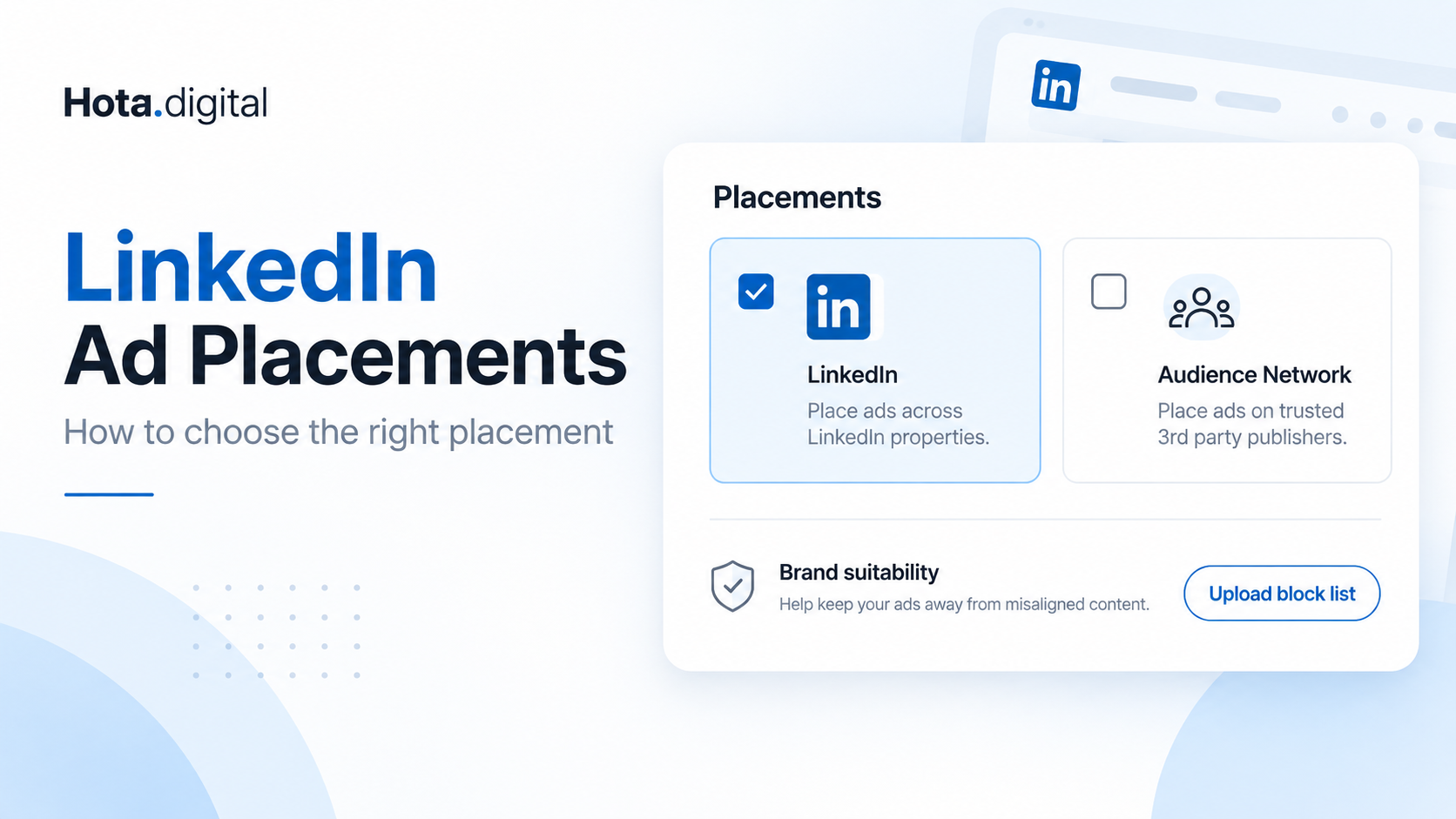
The LinkedIn Audience Network extends eligible LinkedIn campaigns into selected third-party websites and apps where LinkedIn audiences consume content.
According to LinkedIn's Audience Network documentation, the same audience targeting, bid type, and campaign budget can be used while LinkedIn determines where additional delivery opportunities exist.
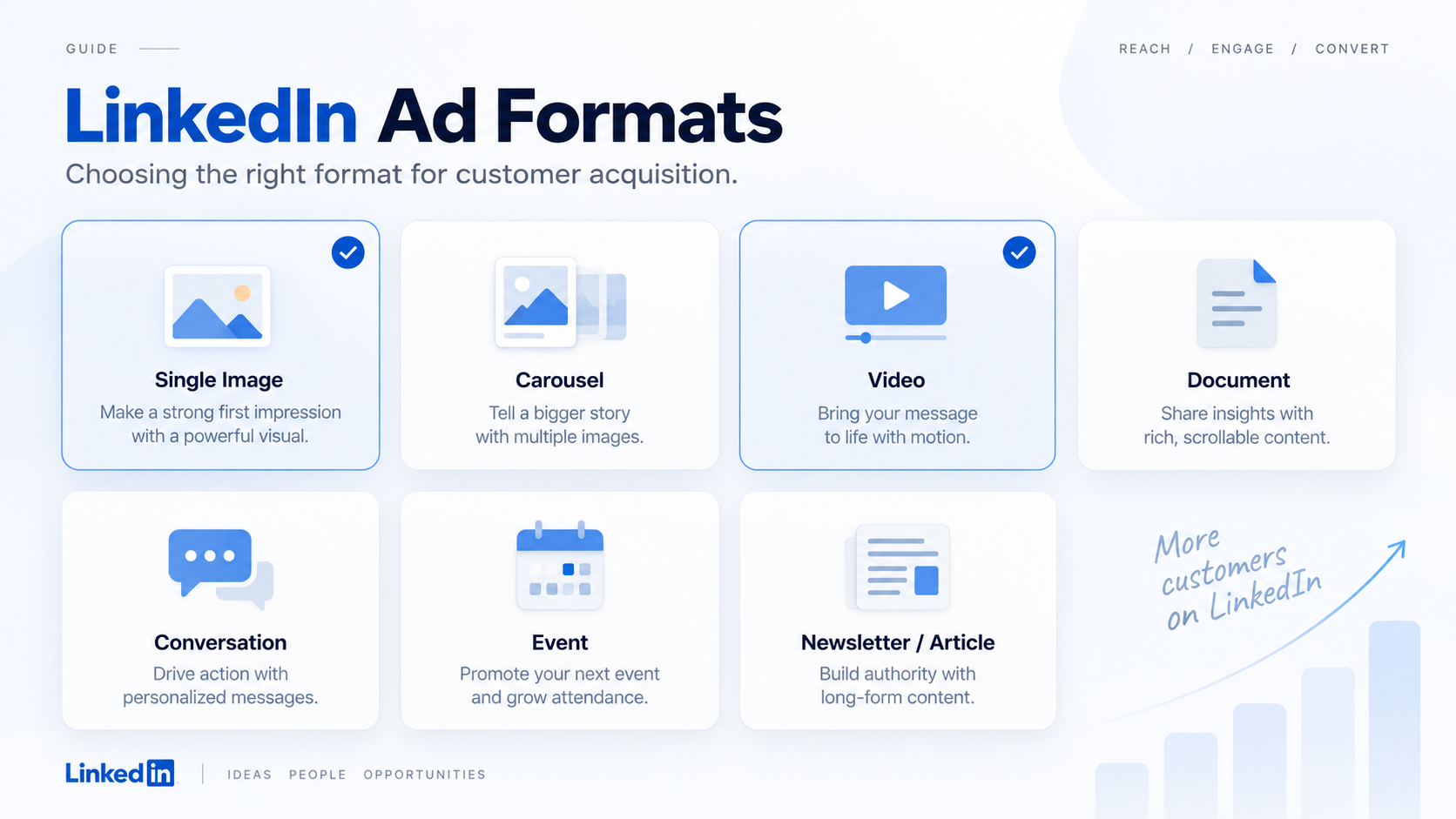
Eligible formats can include formats such as:
- Single Image Ads
- Carousel Ads
- Document Ads
- Video Ads
The important point is that Audience Network does not mean abandoning LinkedIn's audience data.
You are taking the same professional audience definition and giving the system additional places where it can potentially reach those members.
That creates more inventory.
Whether that inventory creates better customer acquisition is something the campaign needs to prove.
Use Audience Network when additional reach solves a real problem
Audience Network becomes more interesting when campaign scale is constrained by available LinkedIn inventory.
This is particularly relevant for broad awareness and demand-generation programs.
Consider a company targeting thousands of relevant SMB owners and functional leaders across the UAE and Saudi Arabia.
The business may benefit from reaching those people beyond the LinkedIn feed.
The same applies to video campaigns, where more inventory creates additional opportunities for the content to be consumed.
There is also evidence that Audience Network can contribute beyond awareness.
In one LinkedIn Audience Network customer case study, a professional-services advertiser reported a 70% reduction in cost per conversion when using LinkedIn Audience Network alongside LinkedIn delivery.
This is a case study rather than a universal benchmark, so businesses should not assume they will automatically see the same result.
The useful lesson is that off-network inventory should not automatically be classified as lower-quality media.
It should be evaluated against business outcomes.
Action to take: If the campaign has sufficient audience scale, test LinkedIn plus Audience Network against a LinkedIn-only control and compare acquisition performance.
Be more careful with narrow institutional and ABM audiences
The logic changes when the addressable market is extremely small.
Suppose a campaign targets 75 strategic companies across banking, payments, insurance, or another institutional sector.
The objective may be to create familiarity among a defined group of executives rather than maximize overall reach.
In this case, context and account penetration can matter more than cheap incremental impressions.
A reasonable approach may be:
LinkedIn-only → establish baseline → introduce Audience Network → compare incremental performance
For institutional campaigns, track whether additional placements are actually helping you reach more relevant people inside the account universe.
Do not assume that higher impression volume means better account penetration.
Action to take: For tightly controlled ABM campaigns, test placement expansion incrementally rather than enabling it by default.
Placement and bidding need to work together
Placement is not an independent media system.
Your campaign objective, optimization goal, bidding strategy, budget, audience, and placement interact with each other.
For example:
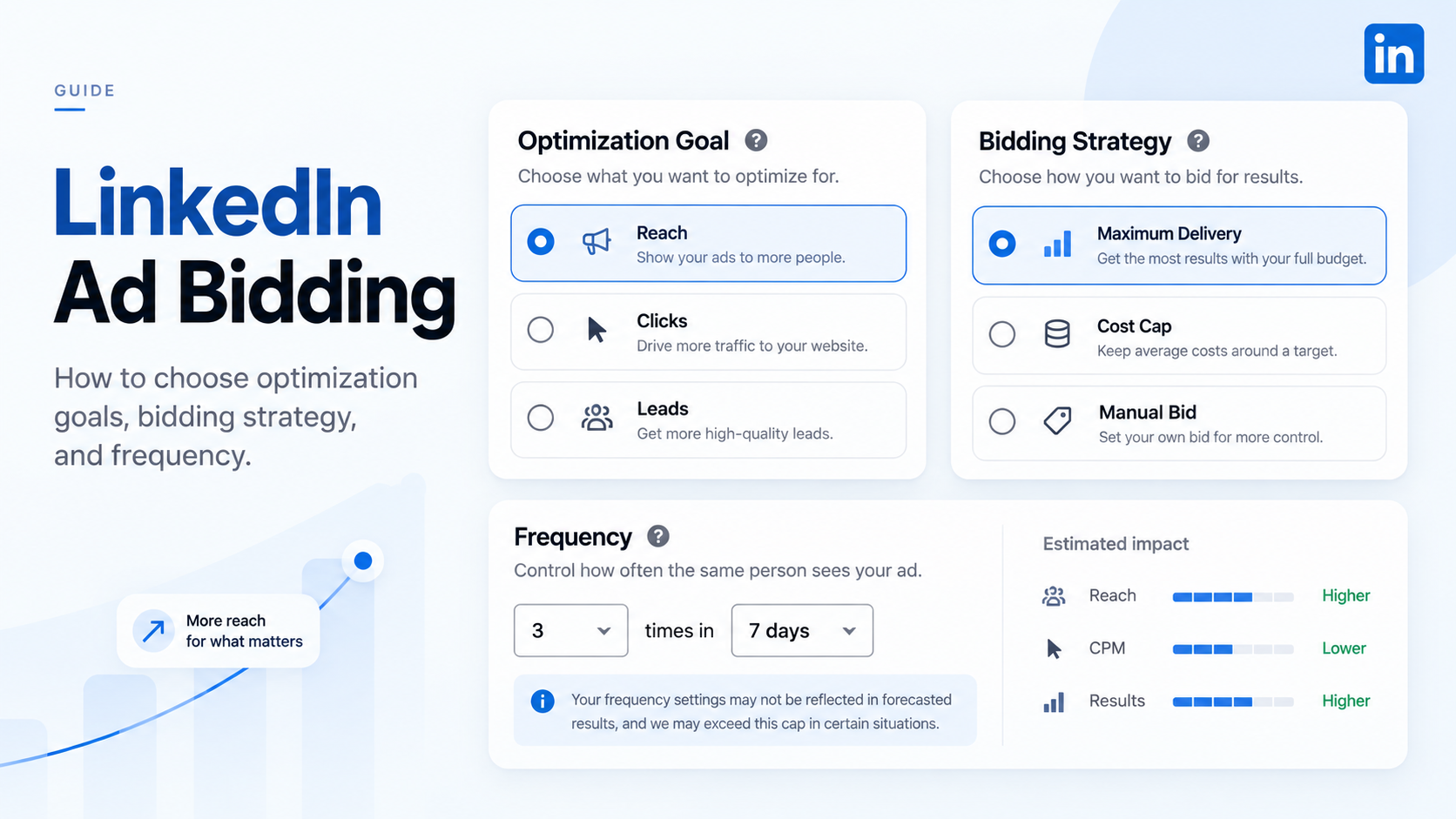
Awareness + Reach optimization + Maximum Delivery + Audience Network
gives LinkedIn more inventory to find additional impressions and reach.
A campaign structured around:
Lead Generation + narrow ICP + LinkedIn-only
gives the system a much more constrained environment.
Neither is inherently better.
They are solving different acquisition problems.
If your priority is reach, broader placement can provide more auction opportunities.
If your priority is qualified pipeline from a small group of decision-makers, more controlled delivery may be preferable.
This is why placement should be decided after the campaign objective and audience are clear.
Do not compare placements using CPM alone
This is one of the easiest ways to make a bad placement decision.
Audience Network may sometimes generate cheaper impressions.
That can make the campaign look more efficient at the media level.
But suppose LinkedIn feed delivery produces:
- higher CPC
- lower click volume
- stronger conversion rate
- higher qualified lead rate
while Audience Network produces:
- cheaper CPM
- cheaper clicks
- lower conversion quality
Which placement is actually more efficient?
The answer depends on what happens after the click.
For awareness campaigns, evaluate:
- unique reach
- CPM
- frequency
- video consumption
- engagement
For consideration campaigns, evaluate:
- landing-page clicks
- engaged sessions
- product-page visits
- retargeting audience growth
- cost per meaningful visitor
For customer acquisition, prioritize:
- leads
- qualified leads
- cost per qualified lead
- opportunity creation
- pipeline generated
- customer acquisition cost
The closer the campaign gets to revenue, the less important CPM becomes as the primary decision metric.
Brand suitability matters when you expand beyond LinkedIn
Additional inventory also creates another question:
Where exactly is the brand appearing?
LinkedIn provides brand suitability controls, including publisher block lists and other mechanisms for managing where Audience Network advertising can appear.
This matters because media quality can affect both reputation and campaign efficiency.
DoubleVerify's 2024 Global Insights Report analysed more than one trillion digital impressions across over 2,000 brands and 100 markets.
The report found that campaigns without appropriate brand suitability protection experienced a 150% higher brand suitability violation rate compared with protected campaigns.
The research is not specific to LinkedIn Audience Network, but it reinforces an important principle for any third-party advertising inventory.
More reach should come with appropriate placement controls.
This can be particularly important for UAE companies operating in:
- financial services
- healthcare
- education
- government-related sectors
- regulated technology
- premium consumer categories
Action to take: Define genuine brand suitability requirements before launch, then apply restrictions based on those requirements rather than blocking large categories without evidence.
Do not over-restrict inventory either
Brand safety controls can also go too far.
Every publisher you exclude reduces available inventory.
If too many placements are blocked, campaign reach can decline and auction costs may increase.
The objective is therefore not:
Block everything that feels remotely risky.
It is:
Remove genuinely unsuitable environments while preserving enough quality inventory for efficient delivery.
This is another reason placement performance should be reviewed with actual data rather than intuition.
Use on-network and off-network reporting
Placement should not be a one-time campaign setting.
Review it regularly.
LinkedIn provides reporting that allows advertisers to separate on-LinkedIn and off-network delivery.
For each placement, compare:
- impressions
- reach
- CPM
- clicks
- CPC
- video performance
- conversions
- cost per conversion
For acquisition campaigns, add CRM outcomes where possible:
- qualified leads
- opportunities
- pipeline
- customers
A placement can look strong inside Campaign Manager and weak once sales qualification is included.
Action to take: Add placement performance to the weekly campaign review rather than waiting until the campaign ends.
Match placement strategy to the funnel
A simple framework can help.
ToFu
Primary goal:
- awareness
- category education
- incremental reach
Audience Network can be useful because scale matters.
Focus on reach, CPM, frequency, and content consumption.
MoFu
Primary goal:
- website visits
- research consumption
- product consideration
Test both LinkedIn and Audience Network.
Measure the quality of traffic, not only CPC.
BoFu
Primary goal:
- leads
- qualified leads
- conversions
Placement quality becomes increasingly important.
Compare qualified lead rate and pipeline by placement wherever your reporting setup allows.
For narrow institutional audiences, LinkedIn-only may deserve more weight until off-network delivery proves incremental value.
Common placement mistakes that waste money
Turning Audience Network on simply because it increases reach
Additional reach only matters if it supports the campaign objective.
Turning Audience Network off without testing it
Some advertisers assume off-network inventory must be lower quality. That assumption can leave useful conversions and scale untapped.
Judging placement by CPM
Cheap impressions can still generate expensive customers.
Using the same placement strategy for SMB and institutional campaigns
A broad UAE SMB campaign and a 50-account ABM campaign have completely different inventory requirements.
Ignoring brand suitability
Third-party inventory should be monitored and governed appropriately.
Blocking too much inventory
Excessive restrictions can reduce reach and increase costs.
Changing placement, audience, bidding, and creative simultaneously
If performance changes, you will not know what caused it.
A practical placement decision framework
Before launch, answer four questions.
1. What is the campaign objective?
Awareness benefits more from scale than high-intent acquisition.
2. How large is the real ICP?
Thousands of UAE and GCC SMB prospects require a different placement strategy from a small institutional account list.
3. How important is context?
Complex and trust-sensitive products may benefit more from professional-context delivery.
4. Can placement performance be measured separately?
If yes, test rather than assume.
The right LinkedIn placement strategy is rarely "Audience Network always on" or "LinkedIn-only forever."
The better approach is:
Start with the customer acquisition objective, give the campaign enough quality inventory to perform, and let placement-level conversion data determine where the next dirham should go.
The cheapest placement is not automatically the best placement.
The placement generating the most impressions is not automatically the best placement.
The right placement is the one that reaches the right buyer in an appropriate context and moves that buyer toward a valuable customer outcome at sustainable economics.