Choosing a LinkedIn ad format is not mainly a creative decision.
It is a customer acquisition decision.
The format determines how much information you can communicate, how much effort the prospect needs to make, and what kind of action naturally follows.
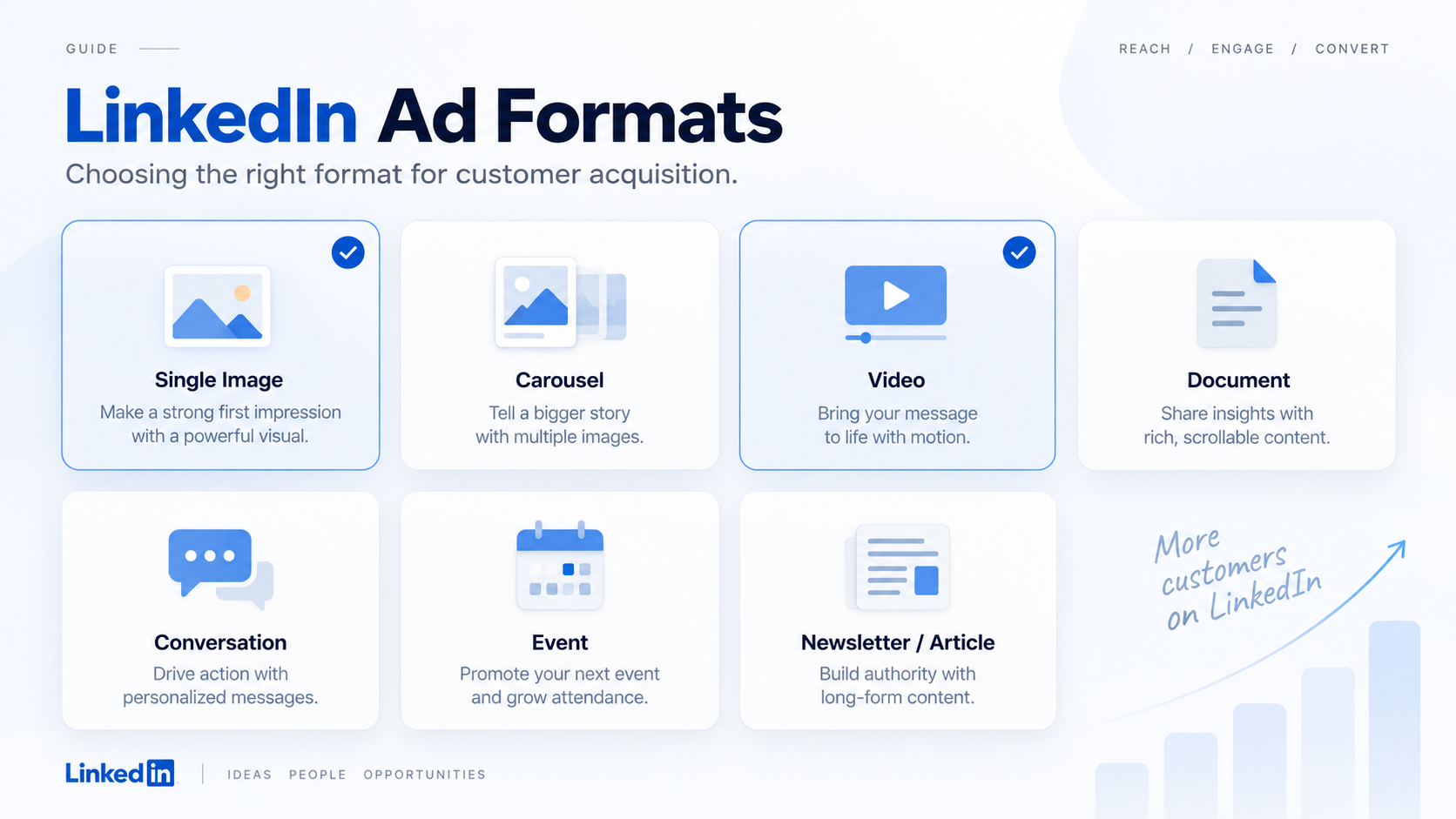
A Single Image Ad can communicate one proposition quickly. A Document Ad can let someone consume several pages of insight without leaving LinkedIn. Video can demonstrate something that would be difficult to explain in static creative. Conversation Ads can give a prospect several possible next steps.
The useful question is therefore not:
Which LinkedIn format performs best?
It is:
Which format gives this buyer the information they need at this stage of the journey, with the least unnecessary friction?
That distinction matters because B2B buying journeys are long.
Dreamdata analysed more than 220,000 customer journeys and 23 million sessions for its 2025 LinkedIn Ads benchmark. It found an average B2B journey of around 211 days, while journeys beginning with a LinkedIn ad impression averaged around 320 days. The same analysis reported 113% ROAS for LinkedIn Ads across its customer dataset. LinkedIn and Dreamdata benchmark analysis
The implication is simple. One ad rarely needs to do everything.
Start with the stage of the customer journey
Most formats become easier to choose when viewed through ToFu, MoFu and BoFu.
At ToFu, the customer may not know the company and may not even be actively shopping.
LinkedIn's B2B Institute has popularised the 95/5 principle, which argues that roughly 95% of potential B2B buyers are out of market at any given time. LinkedIn uses this principle to explain why full-funnel programs generally outperform strategies focused only on immediate conversion. LinkedIn on full-funnel advertising and the 95/5 principle
At MoFu, the customer understands the problem and is consuming information, comparing approaches, or building confidence.
At BoFu, there is enough intent to ask for a demo, submit a form, register for something meaningful, or visit a high-intent page.
The format should match that progression.
Single Image Ads: use them as the control
Single Image is usually the best starting format for customer acquisition because it removes creative complexity.
One message. One visual. One next step.
It can work across the funnel, but it is especially useful when you want to test positioning.
At ToFu, lead with one strong insight or problem.
At MoFu, promote a comparison, use case, or proof point.
At BoFu, move toward a demo, consultation, or other commercial CTA.
The main metrics should change with the objective. CTR and CPC help diagnose creative response, but qualified lead rate, conversion rate, and pipeline contribution matter more once acquisition is the goal.
For UAE businesses with relatively narrow professional audiences, this simplicity is valuable. It is usually better to test three clear propositions with Single Image Ads than build an expensive video campaign before knowing which message resonates.
Action to take: Keep one straightforward Single Image variation running as a control when testing more sophisticated formats.
Video Ads: use them when the buyer needs to understand something
Video becomes valuable when the problem requires explanation, demonstration, or a human voice.
LinkedIn reported in 2025 that video views on the platform were up 36% year over year, while video creation was growing twice as fast as other formats. LinkedIn's 2025 video advertising data
That does not mean video automatically produces better acquisition economics.
Format should follow the job.
Video is useful for:
- product demonstrations
- expert explanations
- new-category education
- customer problems that need context
- software walkthroughs
- proof-led storytelling
LinkedIn's creative analysis has also found that video length affects outcome. In one analysis, videos between 15 and 30 seconds generated a 13% lift in CTR for certain conversion-oriented campaigns. LinkedIn video performance insights
If the objective is consideration, track view rate, average watch time, and 25%, 50%, and 75% completion.
If the campaign is closer to acquisition, connect those metrics to clicks, leads, and pipeline.
A video with high completion but no downstream movement may be interesting content, not effective acquisition content.
Action to take: Compare watch-depth metrics with downstream clicks and conversions. High video engagement without pipeline movement may indicate education rather than acquisition.
Document Ads: strong when expertise is part of the sale
Document Ads are particularly useful for B2B consideration because users can consume the asset directly inside the feed.
Think:
- research reports
- benchmark studies
- buyer guides
- implementation frameworks
- industry analysis
- checklists
LinkedIn has reported that advertisers using Document Ads have seen up to four times higher engagement than Single Image Ads and, in some cases, up to 35% lower cost per lead. These are platform-reported results rather than universal benchmarks, but they illustrate why reducing the gap between ad and content consumption can matter. LinkedIn guidance on Document Ads
A separate LinkedIn case study compared Document Ads with Single Image Ads using the same document, audience, and campaign setup. The Document Ads generated 85% more high-intent leads at a 52% lower cost. This is a case study rather than a market-wide benchmark, but it is a useful example of format and customer behaviour aligning well. LinkedIn case study on Document Ads
For a UAE B2B campaign, this can be especially effective when the content provides local value, such as UAE benchmarks, regulatory analysis, sector research, or implementation guidance.
Action to take: Give enough useful information in the document preview for the buyer to understand why consuming the rest is worthwhile.
Carousel Ads: use them when sequence adds value
Carousel is useful when one visual cannot communicate the complete idea.
A good carousel might move through:
Problem → implication → solution → proof
It can also explain several use cases, buyer objections, or product capabilities.
Do not choose carousel simply because it offers more space.
More cards create more work for the user.
LinkedIn's guidance suggests beginning with roughly three to five cards and measuring individual card performance before expanding the story. LinkedIn overview of ad formats
The useful metric is not only overall CTR. Look at whether engagement collapses after the first few cards.
If users consistently stop at card two, the problem may not be design. You may simply be taking too long to communicate the useful point.
Action to take: Review card-level performance and shorten the story if attention drops sharply before the commercial message appears.
Conversation Ads: useful for high-value, branched journeys
Conversation Ads become interesting when different prospects legitimately need different next steps.
One user might want research.
Another may want product details.
Another may already be ready to speak with sales.
This makes the format potentially useful closer to MoFu and BoFu.
A possible conversation structure could include:
- View the research
- Understand the product
- See implementation details
- Request a consultation
Conversation Ads can work particularly well for institutional acquisition, where the audience is smaller and relevance matters more than raw reach.
LinkedIn published a 2025 case study showing the value of combining formats across the journey. Video was used to generate initial attention, thought leadership warmed the audience, and Conversation Ads were used later to convert interest.
The combined program delivered 2.7x ROAS. The upper-funnel video activity increased dwell time by 95%, while warmed audiences later showed a 229% lift in Lead Gen Form completions. LinkedIn analysis of full-funnel ad format combinations
The lesson is not that every company needs this exact combination.
It is that format performance depends partly on what happened before the ad was served.
Event Ads: useful when attendance moves the buyer forward
Event Ads make sense when attending an event is a meaningful step in the buying process.
They can be useful for:
- webinars
- executive roundtables
- product launches
- industry sessions
- educational events
This is particularly relevant in the UAE, where conferences and in-person industry events can play an important role in B2B customer acquisition.
Do not stop at registration numbers.
Track:
- cost per registration
- attendance rate
- target-account attendance
- meetings created
- pipeline generated
A cheap registration is not valuable if the relevant buyers never attend.
Article and Newsletter Ads: use them to build authority
Article and Newsletter Ads are useful when expertise itself contributes to consideration.
They work best when the business has something worth distributing:
- original research
- a strong point of view
- category education
- sector analysis
- market commentary
These formats usually sit closer to ToFu or MoFu than direct acquisition.
They can also help create audiences that later respond to more commercial campaigns.
Text, Spotlight, and Follower Ads
These formats generally play supporting roles.
Spotlight Ads can help drive website traffic using personalized creative.
Text Ads provide lightweight incremental reach.
Follower Ads are more relevant when growing the LinkedIn Page audience is the goal.
These formats can be useful, but they should not distract from the customer acquisition objective.
The right format is the one that matches what the prospect needs to do next.
How to evaluate a format change
Do not compare ad formats using CTR alone.
A Document Ad and a Single Image Ad are performing different jobs.
When testing one format against another, keep the following reasonably stable:
- audience
- campaign objective
- core proposition
- offer
- landing page
Then change the format.
This gives you a much clearer view of whether the format itself improved performance.
Track metrics according to the job each format performs:
- Single Image: CTR, CPC, conversion rate, qualified CPL
- Video: view rate, watch depth, CTR, conversions
- Document: document consumption, form fills, lead quality
- Carousel: card engagement, CTR, conversion
- Conversation: CTA progression, leads, qualification
- Event: registration, attendance, meetings, pipeline
- Article or Newsletter: engagement, readership, retargeting audience growth
The common denominator is not engagement.
It is commercial progression.
The expensive mistakes to avoid
Choosing format before defining the job
Do not start with "we need a video campaign."
Start with the customer problem and stage of the journey.
Assuming richer creative automatically performs better
Video does not outperform because it moves. Carousel does not outperform because it has more cards.
Comparing everything by CTR
A format designed for content consumption should not be judged in exactly the same way as a direct-response ad.
Using BoFu formats on completely cold audiences
A demo request may be the desired business outcome, but that does not mean every cold prospect is ready for it.
Treating engagement as acquisition
A video view, document open, or carousel swipe is an intermediate signal, not revenue.
Testing too many formats at once
For many UAE B2B campaigns, audiences can already be relatively small. Splitting limited budget across five formats can leave every test underpowered.
Changing too many variables together
If you change the audience, format, objective, offer, and landing page simultaneously, you cannot identify what actually improved performance.
Use the simplest format that can do the job
A practical starting framework is:
If the proposition can be understood immediately, start with Single Image.
If the buyer needs deeper information, test Document.
If the product needs to be demonstrated, use Video.
If the story needs several connected steps, test Carousel.
If different prospects need different next actions, consider Conversation Ads.
If attendance itself advances the buying journey, use Event Ads.
If expertise builds consideration, use Article or Newsletter Ads.
The best LinkedIn ad format is not the one generating the most interaction.
It is the format that moves the right buyer to the next meaningful stage of the customer journey at an acceptable acquisition cost.