Go-to-market maturity is not about adding more software, channels, or people. It is about making revenue generation more repeatable, measurable, connected, and less dependent on individual judgment.
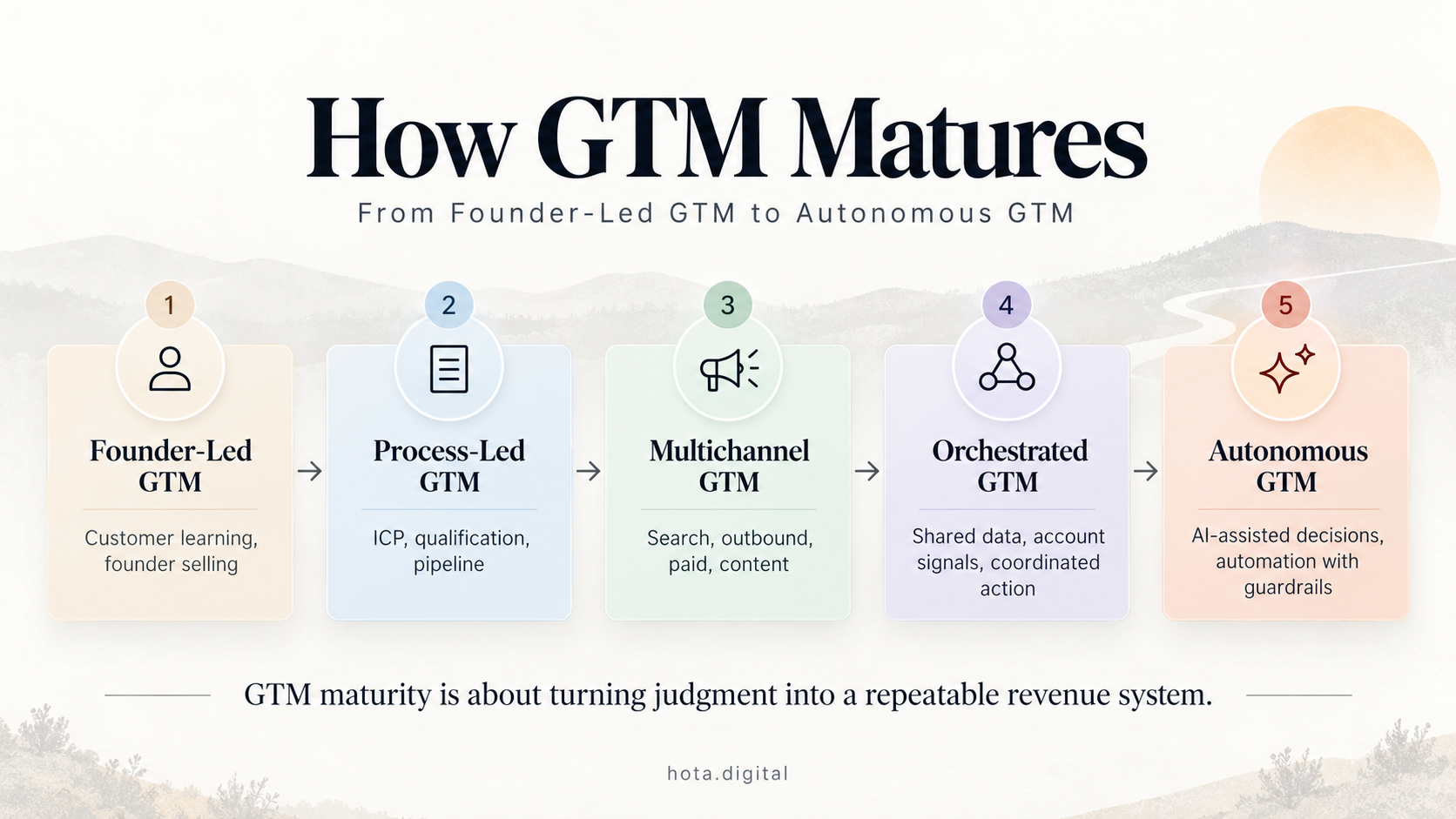
Companies often move through recognizable operating stages: Founder-Led GTM, Process-Led GTM, Multichannel GTM, Orchestrated GTM, and Autonomous GTM. These are not rigid steps. A company can run sophisticated demand generation while still depending on founders to close strategic deals.
Founder-Led GTM
Most companies begin with Founder-Led GTM.
Founders speak directly with customers, test positioning, handle objections, negotiate deals, and learn which problems buyers will actually pay to solve. At this stage, customer learning matters more than sales efficiency.Removing founders from selling too early can weaken that feedback loop.
Founder involvement becomes a problem when it moves from a learning advantage to a capacity constraint.
Suppose a founder can sustainably spend 15 hours per week selling. If every successful deal requires five hours of founder involvement, the business can only support a limited number of founder-dependent wins. Demand may increase, but founder time does not.
That creates a Founder-Led Sales Ceiling.
The Founder-Led Sales Ceiling Calculator helps quantify how much revenue the current founder-dependent motion can support and how much founder involvement needs to fall before a higher revenue target becomes operationally realistic.
The objective is not simply to hire salespeople. It is to identify what the founder has learned about the ICP, qualification, messaging, objections, and closing process, then make that knowledge transferable.
Founder-Led GTM starts maturing when successful selling no longer depends on one person's intuition.
Process-Led GTM
Process-Led GTM begins when successful selling becomes explainable.
The company develops clearer definitions around its ideal customer profile, qualification criteria, opportunity stages, handoffs, average deal size, sales cycle, and conversion rates.
Revenue planning can then move from intuition toward mathematics.
Instead of saying "we need more pipeline," RevOps can ask: how much qualified pipeline do we need given our revenue gap and historical win rate?
Suppose the business needs another $1 million in revenue and historically closes 25% of qualified opportunities.
A simplified model implies:
$1 million ÷ 25% = $4 million of qualified pipeline.
That is approximately 4x pipeline coverage.
But 4x is not a universal benchmark. A business closing 50% of qualified opportunities has very different requirements from one closing 15%.
The Pipeline Coverage Calculator works backward from the revenue gap and historical win rate to estimate required pipeline, new opportunities, meetings, and weekly opportunity creation.
This is the core shift in Process-Led GTM.
Once those relationships become measurable, RevOps can diagnose the actual constraint. Is pipeline creation insufficient? Is win rate declining? Are deals taking too long? Is average deal size falling? Are too few opportunities reaching the qualified stage?
More leads are not always the answer.
Multichannel GTM
Once a commercial motion becomes reasonably repeatable, companies expand it.
Inbound is supplemented by outbound. Organic search operates alongside paid acquisition. Events create conversations. Partnerships generate introductions. Content supports research. Account-based programs concentrate resources on high-value accounts.
This creates more opportunity, but also more complexity.
The buyer is already multichannel. The challenge is making the GTM organization operate the same way.
A company can run paid media, outbound, events, search, content, partnerships, and lifecycle programs while every function optimizes a different metric.
Paid media optimizes CPL. Content optimizes traffic. Outbound optimizes meetings. Events optimize registrations. Sales optimizes opportunities.
Every function can improve its local metric while the revenue engine remains inefficient.
Multichannel GTM becomes more mature when channels are evaluated through common revenue economics.
What does qualified pipeline cost? How much revenue does each acquisition motion generate? How quickly does customer acquisition spend pay back? Which channels produce higher-value customers? Does incremental media spend continue producing incremental revenue?
This is where metrics such as CPM, ROAS, CAC, LTV, and payback become useful.
The CPM Calculator helps assess the cost of buying reach. The ROAS Calculator connects advertising spend with revenue. The Unit Economics Calculator connects acquisition cost, customer value, and payback.
The question changes from "is this channel performing?" to "is this channel contributing economically attractive revenue to the GTM system?"
That distinction matters because activity is not the same as growth.
Orchestrated GTM
Multichannel GTM eventually creates another constraint: fragmentation.
A target account can appear in CRM, paid media, website analytics, events, outbound activity, product usage, customer success, and support systems.
Every system knows something, but the organization may still not know what should happen next.
This is where Orchestrated GTM begins.
The question changes from "which campaign should we run?" to "given everything we know about this account, what is the best next action?"
Imagine an opportunity that has been inactive for two months.
Several people from the account suddenly return to the website. They review pricing, revisit product documentation, engage with new content, and attend an event.
In a fragmented GTM system, marketing sees engagement while sales sees an inactive opportunity.
In an orchestrated system, those signals contribute to the same account-level understanding.
The customer does not experience your CRM, advertising platform, sales team, and website as separate systems. They experience one company.
Orchestrated GTM therefore requires more than automation.
CRM stages need clear meaning. Account identity needs to be consistent. Buyer signals need to move between systems. Ownership needs to be explicit. Teams need to agree on what constitutes meaningful intent and what action should follow.
Measurement also changes.
The goal becomes less about assigning 100% of revenue credit to one touchpoint and more about understanding which interactions contribute to account progression.
The purpose of attribution is better allocation and better decisions. Use B2B Lead Scoring Calculator to combine ICP fit, engagement, intent, and recency into a single priority score that helps revenue teams decide which accounts should receive attention first.
Orchestrated GTM is the transition from channel-level optimization to customer-level decision making.
Autonomous GTM
Autonomous GTM begins when systems move beyond predefined workflows and start participating in decisions.
Traditional automation follows rules.
When this happens, perform that action.
Assign this lead. Create this task. Send this message.
AI-assisted GTM can address more complex questions.
Which accounts deserve attention? Which opportunity appears at risk? What is the buyer researching? Where is pipeline likely to fall short? Which message is relevant? Which campaign should receive incremental investment?
But Autonomous GTM should not mean removing humans from the revenue system.
A more practical model is progressive decision automation.
Systems handle more data collection, pattern recognition, recommendations, prioritization, and low-risk execution. Humans continue setting goals, defining positioning, making strategic trade-offs, and determining what the system is allowed to optimize.
The biggest constraint may not be AI capability. It may be the quality of the GTM data underneath it.
AI cannot compensate for weak ICP definitions, inconsistent opportunity stages, poor qualification, unreliable account data, or unclear goals.
It processes those weaknesses faster.
Autonomous GTM becomes useful after the underlying revenue system is measurable, connected, and trustworthy.
GTM Maturity Is About Where Intelligence Lives
The simplest way to understand GTM maturity is to ask where commercial intelligence lives.
In Founder-Led GTM, much of the intelligence lives inside a few people's heads.
In Process-Led GTM, that knowledge becomes repeatable.
In Multichannel GTM, the repeatable motion expands across acquisition channels.
In Orchestrated GTM, channels, teams, and signals begin operating as one revenue system.
In Autonomous GTM, parts of that accumulated intelligence become executable by software.
A company can have dozens of GTM tools and still depend on founder intuition for major revenue decisions.
Another company may have a smaller stack but clear ICP definitions, reliable opportunity data, disciplined pipeline management, predictable acquisition economics, and defined handoffs.
Do Not Automate What You Do Not Understand
One principle applies across every stage: automation amplifies the underlying process.
Weak targeting becomes more outbound.
Poor messaging becomes more content.
Bad qualification becomes more pipeline.
Unreliable data becomes more sophisticated-looking analysis.
The same principle now applies to AI.
Learn. Standardize. Expand. Connect. Automate.
The exact journey will differ by company, but skipping the underlying learning usually creates complexity rather than scale.
Where Is Your GTM System Today?
Do not try to assign the entire organization one maturity score. Find the constraint.
If strategic deals still require founder involvement, part of the business remains Founder-Led GTM. The Founder-Led Sales Ceiling Calculator can help quantify whether founder capacity is becoming the constraint.
If teams disagree about what constitutes a qualified opportunity, Process-Led GTM is not yet stable.
If several acquisition channels exist but each is measured independently, the company may have reached Multichannel GTM but not Orchestrated GTM.
If buyer signals exist across several systems but nobody knows what action should follow, orchestration is the constraint.
If AI is being deployed before data, process, and governance are reliable, the organization may be moving toward Autonomous GTM too early.
For revenue-planning problems, Hota.Digital's RevOps Tools bring together calculators for pipeline, capacity, and unit economics. For broader planning assumptions, the GTM Planning Tools focus on growth and acquisition decisions.
The objective is not to reach Autonomous GTM as quickly as possible.
It is to identify what prevents the current GTM system from supporting the next level of revenue.
GTM maturity is a progressively more predictable system for turning market demand into revenue.