When an AI system cites a webpage, it usually has a harder problem to solve than a traditional search engine.
It does not simply need to find ten relevant pages. It needs to find information that can help construct an answer, identify the passages that support specific claims, and decide which sources should be shown alongside that answer.
This is why understanding retrieval matters for AI-search visibility.
The useful question is not:
How do we make our article sound more AI-friendly?
It is:
When an AI system goes looking for evidence to answer a customer's question, can it find the right information on our site quickly and confidently?
For UAE businesses, that means combining traditional SEO with stronger passage-level answers, local evidence and content depth around the decisions customers actually make.
First, understand what RAG actually does
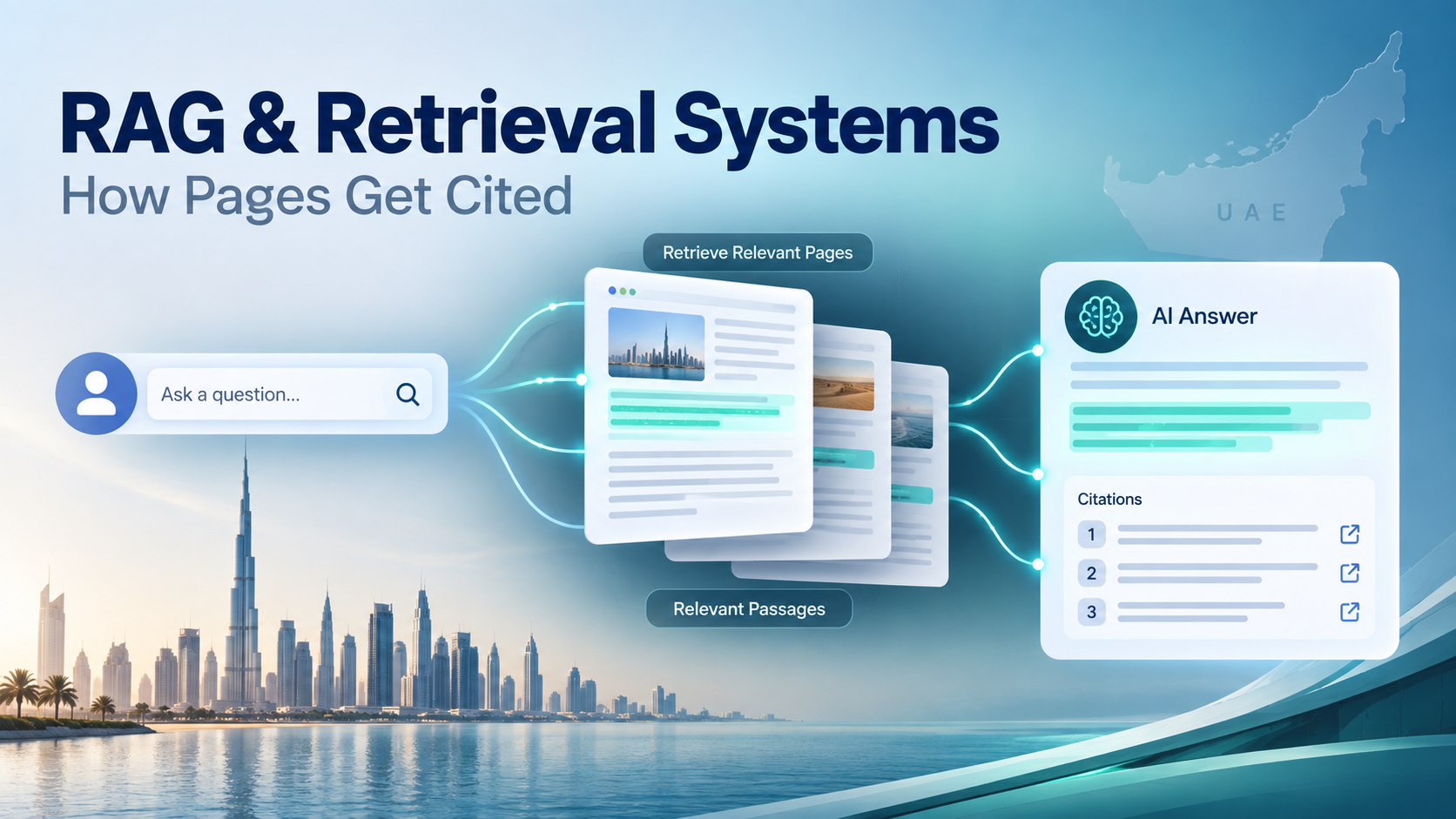
Retrieval-Augmented Generation, or RAG, combines a language model with an external information-retrieval layer.
The foundational 2020 RAG research by Patrick Lewis and colleagues showed how a language model could retrieve external documents before generating an answer rather than relying entirely on information stored in the model's parameters.
Retrieval-Augmented Generation for Knowledge-Intensive NLP Tasks, NeurIPS 2020
Modern AI search systems are more sophisticated and their exact architectures differ, but the basic idea is useful for marketers:
User question → search/retrieval → relevant passages → answer generation → supporting citations
The important part is what happens between the question and the answer.
That is where pages win or lose visibility.
One prompt can create several searches
A customer might ask:
Which digital onboarding approach works best for a regulated financial company in the UAE?
The retrieval system may need information about:
- UAE regulation
- identity verification
- KYC
- implementation
- financial-services categories
- vendor comparisons
- data residency
- pricing
The exact words in the customer's prompt therefore do not need to appear on one page.
Google publicly describes a similar mechanism called query fan-out in AI Mode and AI Overviews. Its systems can generate several related searches across subtopics and data sources before constructing the response.
Google's guide to generative AI search and query fan-out
Google's published Search with Stateful Chat patent also describes the generation of synthetic and follow-up queries used to retrieve responsive search documents. A patent should not be treated as a precise description of the production system, but it illustrates how conversational search can expand beyond the original prompt.
Google patent: Search with Stateful Chat
Microsoft researchers have explored the same problem from another direction. Their Rewrite-Retrieve-Read research showed that rewriting the user's original query can improve the information retrieved before an LLM generates its response.
Query Rewriting in Retrieval-Augmented Large Language Models, EMNLP 2023
The business implication is straightforward:
Do not create one page for every possible prompt. Build enough topic depth to answer the underlying decision.
Make important passages retrievable on their own
Once a page is retrieved, the entire article may not be equally useful.
The system may need one passage answering one specific part of the question.
Consider a 2,000-word article about setting up employee benefits in the UAE.
Buried halfway down is one paragraph explaining:
“Dubai employers with more than 100 employees typically evaluate these three implementation considerations…”
That paragraph may be more useful to an answer than the rest of the article.
Content should therefore have clear information blocks.
Instead of headings such as:
“Introduction”
“Things to Consider”
“Conclusion”
use headings such as:
What are the UAE requirements?
What changes when the company reaches 100 employees?
How much does implementation typically cost?
Dubai vs Abu Dhabi: what changes?
Then answer each question directly before adding supporting detail.
Action: Review your 20 highest-value articles. For each one, identify the five questions a retrieval system should be able to answer without needing context from the entire page.
Build content around decisions, not definitions
Generic definitions are increasingly weak retrieval assets.
There are thousands of pages explaining:
“What is KYC?”
“What is CRM?”
“What is employee insurance?”
Instead, create content around questions where customers need evidence or judgement.
For example:
“UAE KYC Requirements Across Different Financial-Service Categories”
or:
“Employee Benefits Benchmark for 50, 100 and 500-Person UAE Companies”
Those pages contain information that can support specific answers.
OpenAI's earlier WebGPT research demonstrated the broader importance of this model: search the web, inspect information and collect references that support the generated answer.
OpenAI WebGPT research on web browsing and source references
The competitive advantage increasingly comes from having something useful to retrieve, not simply having another article indexed.
UAE specificity can create a retrieval advantage
Local context is particularly valuable because generic global sources often cannot answer UAE-specific questions properly.
A strong UAE page should make important context explicit:
- UAE versus wider GCC applicability
- Dubai versus Abu Dhabi differences
- federal versus emirate-level requirements
- English versus Arabic considerations
- AED pricing assumptions
- regulatory effective dates
- local implementation timelines
For regulatory information, link directly to primary sources such as CBUAE, VARA, DIFC, DFSA, ADGM or relevant ministries.
Original UAE research can be even more valuable.
Consider publishing:
- local pricing benchmarks
- customer surveys
- industry market maps
- implementation benchmarks
- regulatory comparisons
- original datasets
These give retrieval systems evidence that may not exist elsewhere.
Track retrieval visibility, not just AI mentions
The final step is measurement.
Start with 30 to 50 questions taken from:
- sales calls
- demo recordings
- lost deals
- support tickets
- Search Console
- customer interviews
Run those questions regularly across the AI/search platforms relevant to your customers.
Track:
- whether the company appears
- whether the domain is cited
- which exact page gets cited
- which competitors appear
- which external sources dominate
- which topics consistently exclude the business
Then diagnose the gap.
If competitors appear because they have stronger commercial pages, improve the page.
If government sources dominate, add stronger primary-source evidence.
If an entire subtopic is missing, build the missing content.
If the right page exists but is never retrieved, investigate crawlability, indexing, internal links and information structure.
The objective should not be to optimise for an invisible “AI ranking factor.”
It should be much simpler:
Make the best evidence on your topic easy to discover, easy to retrieve and easy to verify.
That is where traditional SEO, RAG and AI-search visibility increasingly meet.
A business that understands customer questions, builds deep UAE-specific information around them and structures that information clearly gives retrieval systems more opportunities to find useful passages.
And if the information genuinely supports the answer, it has a much stronger reason to become the citation.