Getting cited by Claude is not the same as ranking for a keyword.
When Claude uses web search, it can search across multiple sources, retrieve relevant information and provide citations inside its answer. For businesses, this creates a new visibility opportunity: a customer may encounter your research, product information or expertise inside Claude before ever visiting your website.
The question is therefore not:
How do we write content for Claude?
A better question is:
How do we make our information easy to discover, understand, verify and cite when Claude is researching a customer question?
For UAE businesses, that requires combining traditional SEO foundations with stronger local evidence, clearer information architecture and content that adds something genuinely useful to the market.
First, understand who is using Claude
Claude has historically been particularly strong among professional and technical users.
Anthropic's January 2026 Economic Index, based on a privacy-preserving analysis of one million Claude.ai conversations, found that Claude is predominantly used for work. Coding remains one of the most concentrated areas of usage, while adoption also extends into writing, analysis, education, research and increasingly broader business tasks.
More recent Anthropic research shows that usage continues to diversify, while Claude Code and longer-running agentic workflows are becoming increasingly important. Anthropic's June 2026 Economic Index
This matters when deciding whether Claude visibility deserves attention.
It can be particularly relevant for UAE businesses selling:
- SaaS and enterprise software
- developer tools and APIs
- fintech and regtech
- cybersecurity
- professional services
- research-heavy products
- financial and business infrastructure
Consumer companies should not ignore Claude, but the commercial opportunity is likely to be strongest where customers need to research, compare and understand something before buying.
Which Claude models matter?
Claude is not one model.
Anthropic's current active model lineup includes models such as Claude Opus 5, Claude Sonnet 5, Fable 5 and Haiku 4.5, alongside some still-supported earlier versions. The active lineup changes over time, so Anthropic's model documentation is the better reference than building a marketing strategy around one model name.
From a search-visibility perspective, this distinction is less important than it sounds.
A marketing team does not need an “Opus SEO strategy” and a separate “Sonnet SEO strategy.”
The more important layer is Claude's web-search and retrieval capability.
That is where your website can become discoverable and citable.
How Claude discovers information from the web
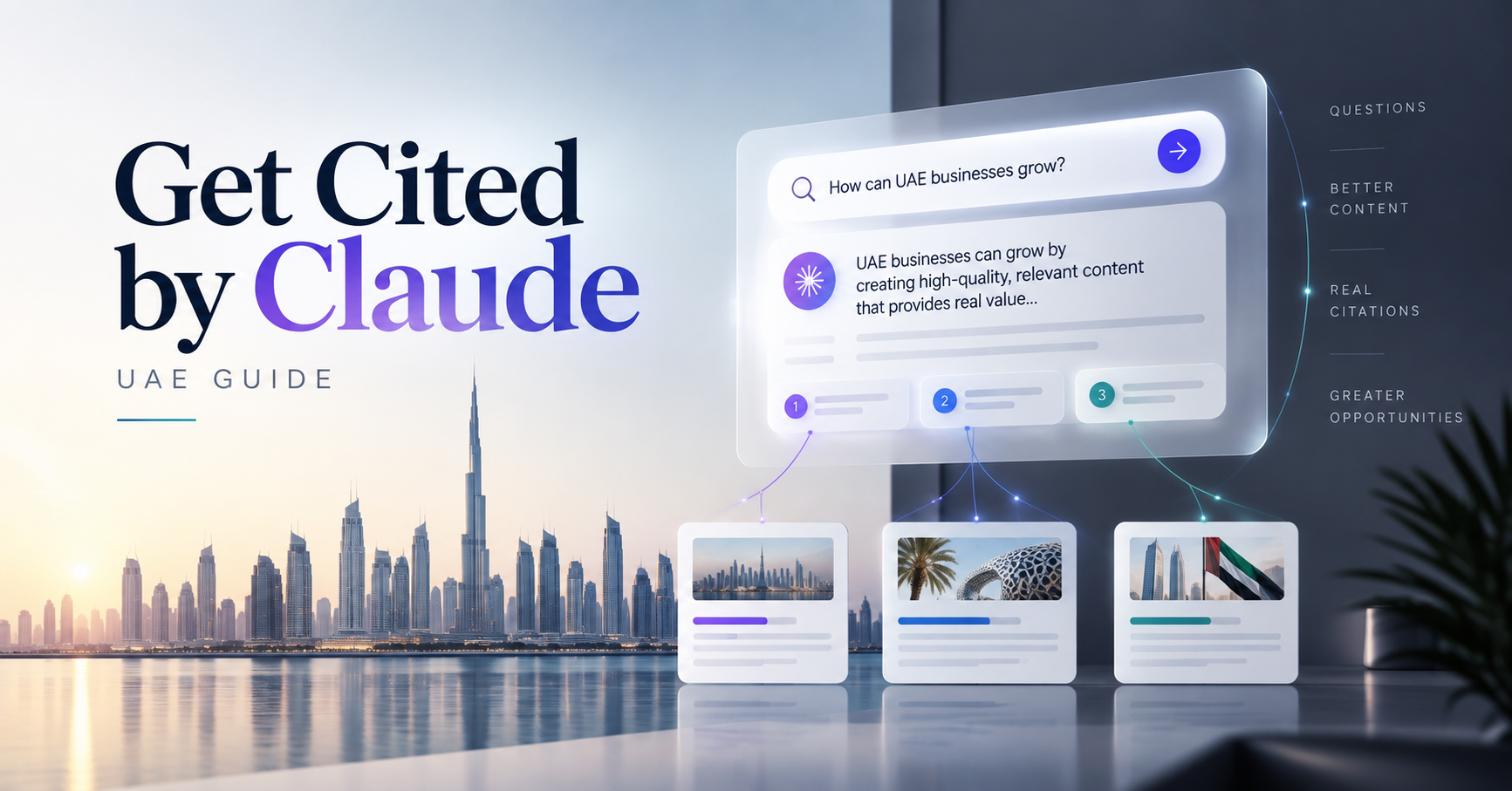
Anthropic explains that when a question benefits from current information, Claude can invoke web search, process multiple sources and use those sources to ground the final response.
Its web-search documentation says Claude can provide direct citations, source links and relevant quotations when web search is used.
Claude's Research mode goes further. It can conduct multiple searches that build on each other, determine what needs further investigation and produce an answer with citations. Anthropic's Research documentation
For marketers, there is an important implication.
A customer's prompt is not necessarily a keyword.
Someone may ask:
Which digital onboarding approaches are suitable for regulated companies operating in the UAE?
Claude may need information about regulation, onboarding, identity verification, implementation, geography and different solution types before producing an answer.
Your site therefore needs enough depth around the decision, not simply one page targeting “digital onboarding UAE.”
Make sure Claude can access the site
Anthropic currently distinguishes between different crawlers, and this is important.
According to its crawler documentation:
- ClaudeBot is associated with collecting web content that may contribute to model development.
- Claude-User can retrieve content when a Claude user asks for information.
- Claude-SearchBot helps Anthropic index content to improve search-result quality.
Blocking ClaudeBot from training is therefore not the same decision as blocking search visibility.
Anthropic explicitly says that blocking Claude-User can reduce visibility in user-directed web search, while blocking Claude-SearchBot can reduce visibility and accuracy in Claude search results.
Action: Ask the technical team to review robots.txt and confirm that Claude-User and Claude-SearchBot are not being unintentionally blocked if Claude search visibility is a goal.
This is one of the most concrete technical checks a business can make.
How Claude decides what to cite
There is no published formula that guarantees citation.
But Anthropic gives us useful clues about how its retrieval system handles sources.
When web search is enabled, Claude can run a search more than once, retrieve multiple sources and cite the source material used in its answer. Anthropic's API documentation also shows that web-search results carry information such as the source URL, title, page age and the specific cited text used in the response.
That does not mean freshness or a particular page format is a confirmed ranking factor.
But it does tell us something useful: Claude needs to retrieve a relevant passage that supports the answer it is constructing.
For content teams, this means the goal should be to make important facts easy to locate and verify.
Structure articles so the useful answer is easy to retrieve
Avoid making Claude, or the customer, read 1,500 words before reaching the actual answer.
A useful page should have a clear hierarchy.
Start with the main answer.
Then explain the evidence.
Then cover the important variations and exceptions.
Use headings that map naturally to customer questions.
For example:
What are the UAE requirements?
Answer the question directly.
How does this differ in Dubai and Abu Dhabi?
Explain the geographic nuance.
What does implementation usually involve?
Give operational detail.
What should businesses compare?
Provide the decision framework.
This works better than artificially filling an article with headings such as “Introduction,” “Benefits” and “Conclusion.”
Action: Take the five questions sales repeatedly hears about the topic and use those questions as the structural backbone of the page.
Put evidence close to the claim
Citation-worthy content should make verification easy.
Instead of writing:
UAE regulation has changed significantly in recent years.
Write:
The relevant regulatory requirement changed in 2026, according to the responsible UAE regulator.
Then link directly to the primary regulatory source.
For UAE-specific content, prioritise sources such as:
- UAE ministries
- Central Bank of the UAE
- VARA
- DIFC
- DFSA
- ADGM
- UAE statistical authorities
- relevant government departments
Avoid citing five secondary articles when one official source answers the question directly.
Claude's own help documentation reminds users to verify important information against original cited sources because the quality of an AI response depends partly on the underlying information it references. Anthropic's guidance on source verification
Original UAE data gives you a stronger reason to be cited
Technical accessibility alone will not create authority.
If ten websites publish essentially the same article, Claude has little reason to rely on yours specifically.
This is where original information becomes valuable.
A UAE business could publish:
- an analysis of 100 companies in its sector
- pricing benchmarks
- customer surveys
- regulatory comparisons
- implementation benchmarks
- market maps
- calculators
- annual UAE industry reports
- original review or search-demand analysis
Instead of publishing:
What is employee health insurance?
publish:
UAE Employee Benefits Benchmark: What Changes Between 50, 100 and 500 Employees?
Instead of:
Guide to KYC
publish:
UAE Digital Onboarding Requirements Across Major Financial-Service Categories.
The second version gives the web something new.
That is the kind of information customers, journalists, other websites and AI research systems have a reason to reference.
Make UAE context explicit
A page should also make its geographic relevance easy to understand.
Clearly identify:
- whether the information applies to the UAE or wider GCC
- which emirates are relevant
- whether a rule is federal or emirate-specific
- publication or update date
- currencies and pricing assumptions
- English versus Arabic considerations
- primary local sources
Do not simply add “UAE” to a generic global article.
Local specificity is the value.
Measure citation visibility as a program
Finally, do not evaluate Claude visibility from one prompt.
Build 20 to 30 commercially important questions from:
- sales calls
- support questions
- lost deals
- customer interviews
- Search Console
- industry discussions
Run them periodically with Claude web search enabled.
Track:
- whether the brand appears
- whether the website is cited
- which page is cited
- which competitors appear
- which external sources Claude prefers
- which commercial topics consistently exclude the company
The objective is not to make every query cite your domain.
It is to gradually increase your presence around the questions that influence customer decisions.
The practical formula is straightforward:
Be technically accessible. Answer the real customer question clearly. Support claims with primary UAE evidence. Add information competitors do not have. Keep important facts easy to retrieve.
There is no guaranteed “Claude citation hack.”
But if the content is accessible, current, specific, well-supported and genuinely useful, you give Claude a much stronger reason to use it when researching an answer.