LinkedIn targeting can look deceptively simple.
Choose a location, add a few job titles, select company size, upload an account list, and launch.
The problem is that every additional condition changes who the algorithm is allowed to reach. A campaign can therefore fail before the first impression is served, not because the creative is weak, but because the audience has been defined badly.
For customer acquisition, the objective is not to create the narrowest possible audience.
It is to create an audience that is commercially relevant but still large enough for LinkedIn to learn and deliver efficiently.
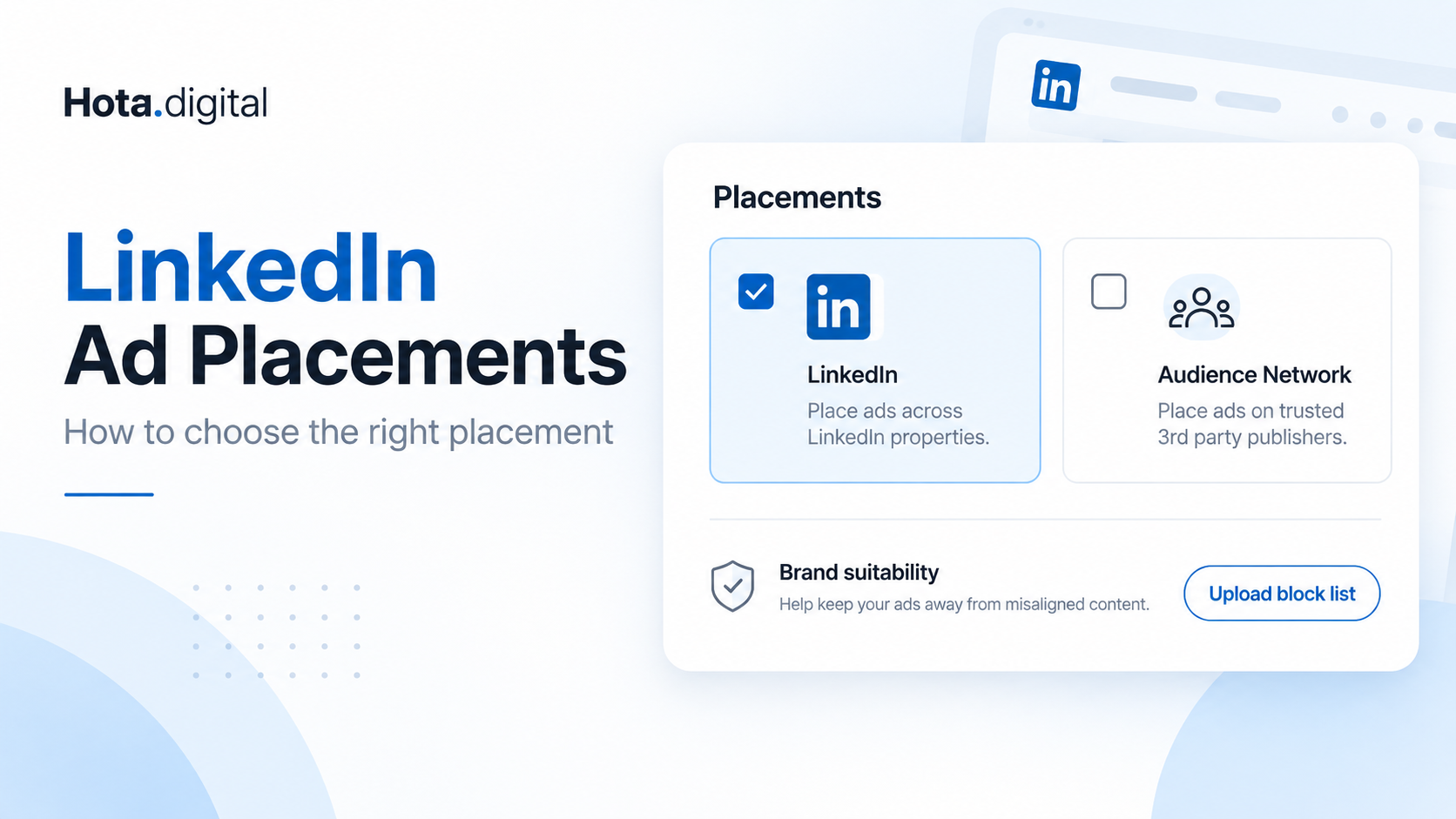
LinkedIn currently lets advertisers build audiences using location, professional attributes, Matched Audiences, predictive audiences, and AI-assisted targeting options. LinkedIn's current targeting options
The starting point should be the ICP.
Start with the ICP before opening Campaign Manager
An ICP should answer two different questions:
Which companies should we sell to?
and:
Which people inside those companies influence the purchase?
Those should not be mixed together.
For an SMB product, the account criteria might include:
- geography
- company size
- industry
- growth stage
- technology or operational need
The buyer may then be a founder, finance leader, operations head, or functional owner.
For institutional sales, the account definition usually matters even more. A target account may have several relevant buyers, including an economic buyer, technical evaluator, operational stakeholder, compliance stakeholder, and eventual user.
That is why targeting only one title such as "CFO" can be unnecessarily restrictive.
LinkedIn's Buyer Groups functionality is designed around this reality. LinkedIn describes buyer groups as a way to reach the decision-makers and key stakeholders collectively involved in purchasing decisions. LinkedIn Buyer Groups
Action to take: Define the account ICP first, then list the three to five buyer profiles that participate in the decision. Build audiences around those two layers.
Geography comes before persona
Location is a required part of LinkedIn targeting and deserves more thought than simply adding "United Arab Emirates."
For a UAE acquisition program, ask whether the actual buying market is:
- the whole UAE
- Dubai
- Abu Dhabi
- UAE plus Saudi Arabia
- the wider GCC
- UAE-based decision-makers responsible for international markets
The answer should follow the sales territory.
Profile language also matters in the UAE.
LinkedIn states that selecting English as the profile language can target eligible members in the selected location regardless of the language selected on their profile, except for Sponsored Messaging. Selecting another language can restrict delivery to accounts matching that profile language. LinkedIn targeting guidance
That matters in a multilingual market such as the UAE.
Do not automatically create a separate Arabic audience simply because the market is Arabic-speaking. First understand the language actually used by the buyer during research and purchasing.
Understand AND versus OR targeting
This is one of the easiest ways to accidentally destroy an audience.
Suppose you include:
CFO OR Treasurer OR Head of Finance
and then add:
AND company size 201 to 500
and then:
AND company list
The final audience needs to satisfy every AND layer.
That can be exactly what you want for a tightly controlled account-based campaign.
The problem begins when more conditions are added simply because they are available.
You might then add industry, seniority, skills, years of experience, and another professional attribute. The theoretically perfect audience can quickly become too small for efficient delivery.
Use OR to expand within a persona concept.
Use AND only when the condition is genuinely required for qualification.
Action to take: For every AND condition, ask: "Would sales reject this prospect if they did not meet this requirement?" If the answer is no, consider removing the condition.
Job titles are powerful, but not always precise
Job-title targeting feels accurate because it looks specific.
In reality, titles vary significantly between companies.
One organisation might use "Treasurer." Another may use "Head of Treasury." In smaller businesses, the founder or finance director may own exactly the same decision.
This is why it can be useful to combine or test:
- job titles
- job functions
- seniority
- company size
- industry
- skills
For SMB acquisition, job function plus seniority can sometimes provide more useful scale than maintaining a list of dozens of titles.
For institutional targeting, more specific titles may make sense because the buyer universe is smaller and better understood.
The bigger issue is messaging.
A CFO and a technical evaluator may both participate in the same buying process, but they are not solving the same problem.
Do not confuse one ICP with one message.
Action to take: Separate buyer profiles when their reasons for buying are materially different. Give each persona creative and landing-page messaging that reflects the part of the decision they own.
Use company lists when the account really matters
Matched Audiences allow advertisers to build audiences using sources such as contact lists, company lists, website visitors, and engagement audiences. LinkedIn Matched Audiences
Company lists are particularly useful for account-based acquisition.
Instead of saying:
Show ads to finance leaders in fintech companies.
you can say:
Show ads to relevant finance leaders inside these 200 target companies.
That changes the campaign from broad demand generation to account penetration.
This can be especially useful in UAE institutional sales, where the realistic universe of banks, large enterprises, major family groups, government-related organisations, or strategic accounts may be relatively small.
However, uploading an account list is only the first step.
You still need to identify the right stakeholders inside those accounts.
Action to take: Split company lists into meaningful priority groups such as Tier 1, Tier 2, and broader ICP. Adjust budget, messaging, and acceptable frequency by tier.
Retargeting should reflect behaviour
Website visitors should not automatically be treated as one audience.
Someone who visited the homepage once is different from someone who read a product page, implementation guide, pricing page, or comparison page.
Where audience volume allows, create retargeting based on meaningful intent.
A simple progression might be:
Cold ICP → content visitor → product visitor → high-intent visitor → conversion
The message should change as intent increases.
Cold audiences may need an insight or problem-led message.
Someone who has already viewed a product page may be more receptive to implementation proof, a comparison, case evidence, or a demo request.
Predictive audiences depend on the quality of the seed
LinkedIn's predictive audiences use a source audience and AI modelling to find members predicted to behave similarly. Sources can include Lead Gen Forms, contact or company lists, conversions, and retargeting audiences. LinkedIn currently requires an eligible source with at least 300 member accounts. LinkedIn Predictive Audiences
The important part is not simply using predictive targeting.
It is choosing the right seed.
A list of every ebook downloader tells LinkedIn something very different from a list of qualified opportunities or converted customers.
Action to take: Use the closest available signal to revenue. Where possible, build predictive audiences from qualified leads, opportunities, or high-quality customers rather than low-intent form fills.
Treat Audience Expansion carefully
Audience Expansion allows LinkedIn to reach additional members who are similar to the audience you selected.
This can help when the objective is scale.
It can be counterproductive when the objective is strict account control.
If the requirement is:
Reach only these strategic accounts.
then expansion may weaken the campaign logic.
If the requirement is:
Find more qualified prospects similar to our ICP.
then expansion may be useful.
Action to take: Decide whether the campaign is designed for precision or discovery before enabling expansion. Do not turn it on simply because the platform recommends it.
Exclusion is part of audience strategy
Good targeting is partly about deciding who should not receive the ad.
Useful exclusions can include:
- existing customers
- employees
- competitors
- companies outside the ICP
- irrelevant job functions
- existing opportunities
- previously converted leads
- accounts handled through another campaign
- markets sales cannot currently serve
LinkedIn supports exclusions using both professional attributes and Matched Audiences, depending on the campaign setup. LinkedIn targeting options
This can have a direct financial impact.
If impressions are repeatedly being delivered to employees, customers, competitors, or companies that sales will never pursue, that budget is unavailable for actual acquisition.
Action to take: Maintain a reusable exclusion library that is reviewed alongside your ICP lists. Do not rebuild exclusions from memory every time a campaign is launched.
Use forecasting as a warning system, not a promise
LinkedIn Campaign Manager can provide forecasts for audience size, spend, reach, frequency, and other expected outcomes depending on the campaign setup.
These are estimates, not guaranteed results.
Their real value is diagnostic.
Suppose your target audience has approximately 660 members, forecasted 30-day reach is only 170 to 300, and average frequency is expected to reach 14 to 22.
That should trigger questions.
The audience may be too narrow.
The budget may be too aggressive relative to available inventory.
The same people may see the campaign repeatedly while much of the intended account universe remains unreached.
For a small Tier 1 institutional audience, relatively high frequency may be intentional.
For ordinary acquisition, it can quickly become waste.
Action to take: Review audience size, forecasted reach, budget, and frequency together before launch. Audience size alone tells you very little about whether the campaign is healthy.
The most expensive audience mistakes
Several mistakes repeatedly waste both money and time.
Over-targeting: Too many AND conditions produce an audience that looks perfect in a spreadsheet but cannot deliver efficiently.
Mixing personas: Founders, CFOs, technical users, and operational stakeholders receive the same message even though their buying concerns differ.
Targeting relevant titles inside irrelevant companies: Persona relevance does not compensate for poor account qualification.
Using weak predictive seeds: Low-quality source data teaches the system to find more people similar to low-quality leads.
Forgetting exclusions: Customers, employees, competitors, and irrelevant accounts consume impressions.
Using expansion during strict ABM: Delivery moves outside the account universe the campaign was created to penetrate.
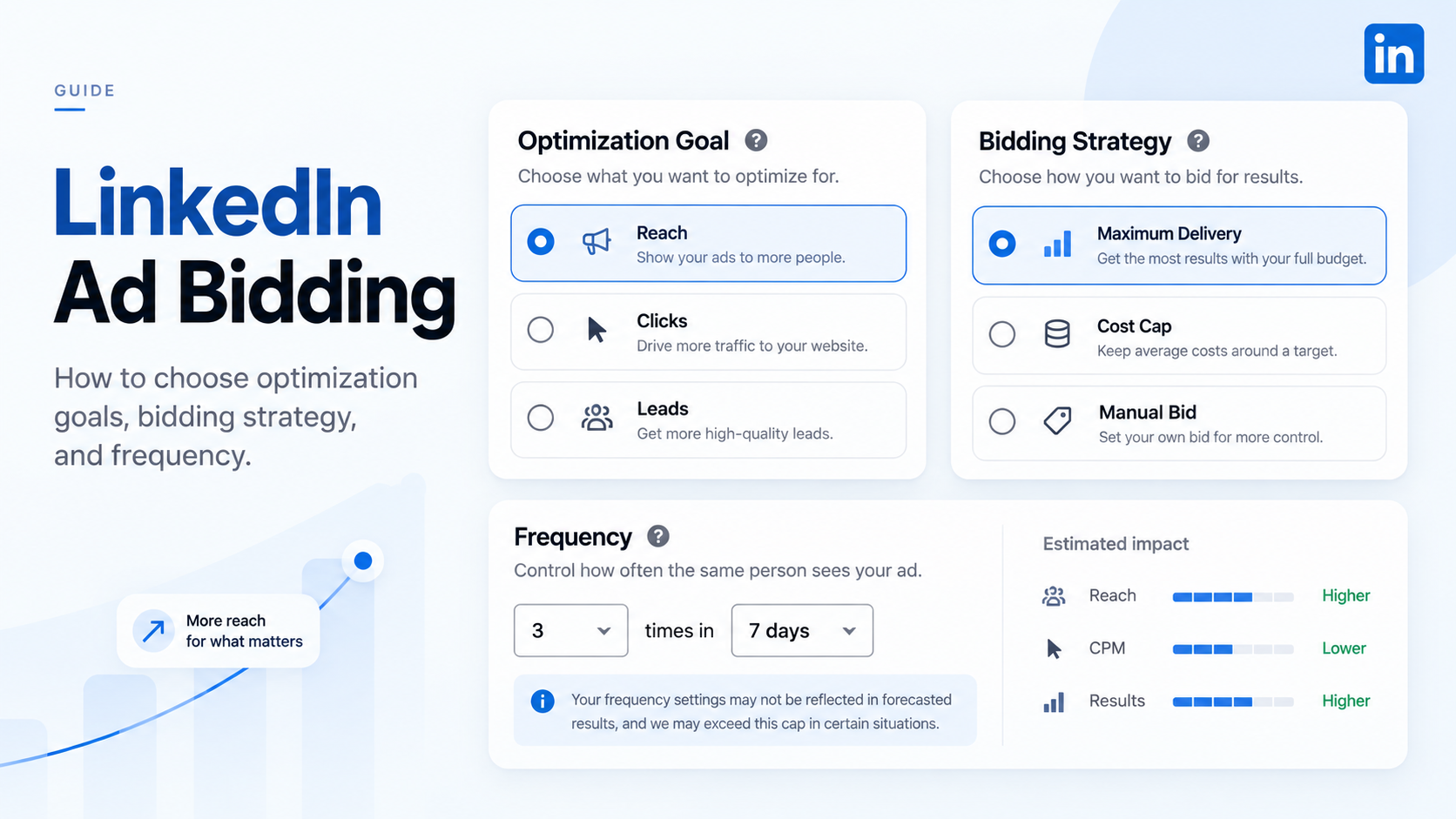
There is also an important objective mismatch.
A perfectly designed audience cannot rescue a campaign optimized for the wrong behaviour.
If the real requirement is qualified leads but the campaign is optimized primarily for website visits, the objective and audience are solving different problems.
Build the audience around the buying market
A useful LinkedIn audience framework is:
Account ICP → Buyer profiles → Geography → First-party signals → Exclusions → Forecast
Then personalize the campaign around the segments that genuinely behave differently.
For SMB acquisition, that may mean broader company criteria, fewer decision-makers, and a more direct conversion path.
For institutional acquisition, it may mean a tightly defined account list with several stakeholders inside each company and different messaging for finance, product, technical, or operational buyers.
The goal is not maximum reach.
It is also not the smallest possible audience.
It is to give LinkedIn enough room to optimize while keeping every impression commercially defensible.
If you cannot explain why an inclusion or exclusion exists, the audience is probably more complicated than it needs to be.